

Canada loves to pretend that it is a developed, civilized and advanced society with incorruptible institutions that govern its people according to the principles of equal justice for all.
But it is painfully apparent that the system beneath it has changed drastically over the past decade or so. And that change is nowhere more evident than in policing.
Police officers now work inside institutions that are more and more driven by political priorities, identity politics, and a compromised justice system that insists courts consider an offender’s background when determining how the law should be applied.
The result is a police officer who may hesitate before confronting disorder, but who is given growing responsibility for investigating the words, opinions and political conduct of otherwise peaceful citizens. Meanwhile, some of our police services no longer even require the people exercising these powers to be Canadian citizens.
If policing is no longer politically neutral, citizenship is no longer required of the people enforcing the law, and the law itself is no longer applied by the same standard, then the question is: how exactly are Canadians still equal under it?
We will begin with the claim that everything else depends on: the idea that Canadian police operate independently of political power.
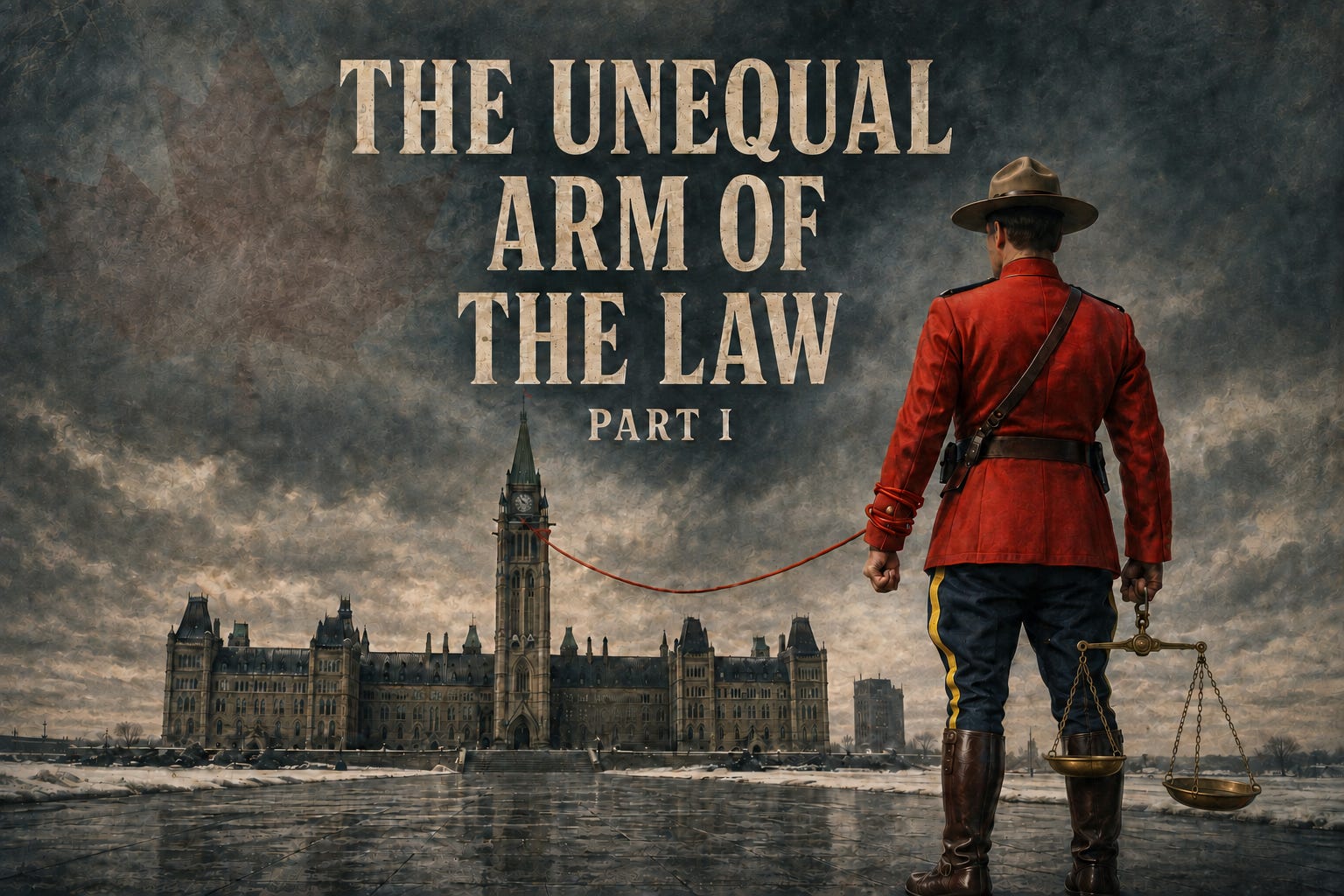
Canadians are repeatedly told that the police operate “at arm’s length” from the government. That phrase is intended to stop any criticism. Politicians make the law, police enforce the law, and operational investigations stay free of political interference.
But the truth is a whole lot less tidy than that.
Independent from Whom?
Detective Helen Grus was an experienced member of the Ottawa Police Service’s Sexual Assault and Child Abuse Unit, which investigates the sudden and unexplained deaths of young children.
In January 2022, Grus learned of what looked like a jump in the number of infant deaths her unit was investigating. During a meeting with then-chief Peter Sloly, Acting Deputy Chief Patricia Ferguson and other senior officials, she stated that there had been six infant deaths during the previous year, compared with the two or three she understood to be usual in other years.
She was careful to say that she was not a doctor and could not directly link those deaths to COVID-19 vaccination. But she believed the increase was concerning enough that it deserved a closer look.
So she started looking.
Grus reviewed police files involving infant deaths and considered whether the vaccination status of the mothers might be relevant. She eventually suspected that the “safe and effective” promises that were made to pregnant and breastfeeding women by government and public-health officials could potentially amount to criminal negligence if those promises had been made without adequate safety information.
The problem was that the people she was starting to look at weren’t just ordinary citizens. They were government and public-health officials.
That difference appears to have changed everything.
Grus was suspended in February 2022 and then dragged through a disciplinary process that lasted years. In March 2025, a police tribunal found her guilty of discreditable conduct.
The official case against her deserves to be stated fairly.
The charge involved nine child or infant death investigations in which Grus was not the assigned detective. The prosecution counted 22 database queries involving those reports. The tribunal found that she had failed to create a proper investigative plan, chronology or adequate record of her findings. It also found that she failed to inform the lead investigators and her immediate supervisors of her own investigation.
Most seriously, she contacted the father of one deceased infant and asked whether the child’s mother had received the COVID-19 vaccine. She did so without informing the detective assigned to the case.
Those are legitimate concerns. Infant-death files contain some of the most private and painful information imaginable. Investigators have to protect grieving families, document what they are doing and avoid interfering with investigations assigned to other officers.
If that was the whole story, the decision against Grus would be much easier to understand. But it is not the whole story. In fact, some of the most troubling evidence in her favour can be found in the tribunal’s own decision.
The hearing was told that investigators in the unit routinely accessed and reviewed one another’s files. They did so to conduct informal case reviews, share investigative experience and mentor less-experienced officers. According to the evidence, this practice was encouraged by sergeants and generally welcomed by the assigned investigators.
As a former police officer, I can confirm that this is a very common practice indeed. When I first started out, I would spend hours at a time reading other officers’ files to see how they worded their reports and to learn how they handled certain investigations. Moreover, reviewing other investigations is a vital part of policing in general. Even experienced officers frequently query other police files to learn what the usual suspects are up to or how a particularly serious event was resolved. In many investigations, failing to check related files can create a serious risk to both officer and public safety.
A Professional Standards investigator also examined an allegation that Grus searched those nine infant-death files for personal reasons. He concluded that the allegation was unfounded.
So in other words, accessing a file to which an investigator had not been formally assigned was not, by itself, some unheard-of violation. It was common practice inside the unit. What made Grus different was what she was looking for and where her suspicions were beginning to lead.
The chain-of-command issue is not as clean as the tribunal made it sound either.
Grus did not fully brief her immediate supervisors or the detectives responsible for the individual files. That is an important fact and should not be missed. But neither did she keep her concerns entirely to herself.
She raised the increase in infant deaths directly with the chief and acting deputy chief during the January 2022 meeting. She told them that she could not establish a connection to vaccination, but that the numbers concerned her. The tribunal still decided she had been too vague for those comments to count as proper notice or approval.
That may be a reasonable criticism of how she communicated. But it does not justify describing her as though she secretly searched the files for an entirely personal reason and told nobody in authority.
The tribunal also heard evidence from retired Ottawa police Staff Sergeant Peter Danyluk. He stated that there was no fixed limit on police discretion where an officer believed community safety was involved. Danyluk acknowledged that leadership should know what its officers were doing, but described police chains of command as sometimes hierarchical, overlapping or even ad hoc.
Again, from personal experience, I can confirm that police discretion is quite broad in practice. Whenever I initiated an investigation into a previously unreported matter, I did so based on my own observations or facts that had come to my attention. I never received criticism from my supervisors merely for starting an investigation without prior authorization. To the contrary, that kind of initiative was usually regarded as the sign of a well-functioning police officer. I never took on the government in quite the same way that Grus did, however. That difference may be the most important one.
The hearing officer rejected the idea that Grus could regard the chief and acting deputy chief as an alternative chain of command. He found that she had deliberately avoided her immediate supervisors because she believed they would shut down her investigation.
Maybe she did. But that brings us straight to the question this article is asking:
What happens when the people who are supposed to authorize an investigation are also the ones most likely to prevent it because of where it might lead?
Former police officers Donald Best and Vincent Gircys have been among the loudest critics of the proceedings.
Best is an advocate, not a neutral observer, and Gircys makes no secret of where he stands. Some of the more explosive allegations surrounding the case have not been proven and should not be presented as fact.
But their core criticism doesn’t require taking either man’s word for it. It’s written into the tribunal’s own decision.
The hearing officer concluded that any investigation of this kind would require special consideration “due to the political and societal ramifications entailed,” along with “clear and specific authorization before any such inquiries were undertaken.”
Read that again.
The tribunal didn’t just say that an officer had improperly wandered into another detective’s routine investigation. It said that even preliminary inquiries would require specific authorization because of their political and societal ramifications.
It also stressed that the potential subjects were public-health and government officials.
That’s a remarkable limit to put on police discretion.
If a police officer suspects an ordinary citizen of criminal negligence, the officer will usually begin gathering information to determine whether reasonable grounds exist to continue the investigation. But if the same suspicion leads toward government officials and carries political consequences, the police agency must first consult its lawyers, medical experts, prosecutors and executive command before the officer can even begin preliminary inquiries.
The tribunal argued that Grus risked politicizing police authority by investigating public officials. But requiring executive permission because an investigation might embarrass those officials is itself a political restriction on police work.
It turns the principle of police independence upside down.
None of this proves that Grus was right. But it also doesn’t prove that she was wrong. That question was never decided by the tribunal, and the inquiry she started was shut down before it could answer anything.
Recently released messages make that distinction more important. In January 2021, Anthony Fauci privately raised the possibility that the fever and immune response after a second vaccine dose could theoretically be linked to first-trimester miscarriage.
The same exchange noted that no problems had shown up among more than 10,000 vaccinated pregnant women, and subsequent population studies haven’t established an increased risk of miscarriage. That evidence should be acknowledged. But it does not mean that every possible question has been answered, particularly when pregnant women had been excluded from the original clinical trials and the evidence available in early 2022 was far less developed.
The messages do not vindicate Grus or establish any connection to the deaths she examined. They do, however, show that senior public-health officials in the United States had privately considered a theoretical pregnancy-related risk similar to the one she later believed warranted investigation.
That makes her decision to ask about maternal vaccination status a lot less irrational than the tribunal made it sound.
Her record-keeping, communication and decision to contact the father are separate procedural questions. Those actions can be criticized without pretending that the underlying question was inherently illegitimate.
Police officers are not supposed to know the answer before they begin asking questions. The whole point of a preliminary inquiry is to find out whether a suspicion has any foundation.
The important question isn’t whether Helen Grus was ultimately right about the cause of those deaths. It’s whether another detective, chasing a less politically dangerous possibility, would have been treated the same way.
Would years of disciplinary proceedings have followed if she had suspected bad baby formula, an unsafe medication, or problems at a private daycare? Would preliminary inquiries have required the knowledge and specific authorization of the executive command because they carried “political and societal ramifications”?
I highly doubt it.
The official decision went a lot further than just dealing with those procedural problems. It established that an officer’s investigative discretion gets narrower when the suspected conduct involves government officials and the possible fallout becomes politically explosive.
That is not police independence.
It is permission to investigate the powerless while needing permission to investigate power.
Pressure From the Other Direction
If the Helen Grus case shows how institutional control can prevent an inquiry from reaching the upper levels of society, the Brenda Lucki controversy shows just how easily political expectations can travel in the opposite direction.
The “arm’s length” story we’ve been sold leads us to believe that police agencies are completely separate and independent from government direction. But when you spend some time thinking this through, you really have to wonder how independent a political appointee will really be when push comes to shove.
We all know the political game. Governments have always used appointments to reward allies and install people they trust. That does not mean Lucki was unqualified. But it does mean that the RCMP commissioner owes her appointment to the government from which she is supposed to maintain operational independence.
In practice, the prime minister chooses the RCMP commissioner. The appointment may be formally made by the Governor in Council, but nobody seriously imagines that the Governor General actually selects the person who will lead Canada’s national police force.
The RCMP’s supposed separation from government is messier than Canadians are being told. Subsection 5(1) of the Royal Canadian Mounted Police Act says that the commissioner holds office “during pleasure” and exercises control and management of the Force “under the direction of the Minister.”
That is not complete institutional independence, but rather a carefully managed relationship where the government is permitted to generally direct the organization but not interfere with individual criminal investigations.
The Supreme Court of Canada drew that line in R. v. Campbell. When RCMP officers are conducting a criminal investigation, the Court said, they are not acting as servants or agents of the Crown. They answer to the law rather than to political direction.
In principle, this sounds fairly straightforward. The challenging part is recognizing political direction when it is disguised as a request for information, an expectation about communications, or a commissioner’s desire to keep the government that appointed her happy. So I wonder: what happens when the government is no longer pleased?
That problem became impossible to ignore following the April 2020 Nova Scotia mass shooting.
On April 28, senior RCMP officials in Nova Scotia held a press conference about the investigation. They did not release the makes and models of the firearms used by the killer. Later that day, Lucki convened a teleconference with senior RCMP officers and staff in Nova Scotia and Ottawa. According to multiple senior officers who participated, Commissioner Brenda Lucki was furious that the firearms information had not been disclosed.
Then-Superintendent Darren Campbell, the senior Nova Scotia RCMP officer who had briefed the media that day and who participated in the subsequent call, recorded in his police notes that Lucki said she had “promised” Public Safety Minister Bill Blair and the Prime Minister’s Office that the firearms details would be released. His notes also connected the requested disclosure to upcoming federal gun-control legislation.
This wasn’t simply one officer’s recollection. Assistant Commissioner Lee Bergerman later testified that part of the conversation was about pressure from the minister to release the calibres, makes and models of the firearms in question. Chief Superintendent Chris Leather eventually stated that, once he learned more about what was going on, he was left with the impression that political interference had taken place.
Lucki and Blair both denied that the government improperly directed the investigation. Blair testified that he never asked Lucki to release the information and never told RCMP what to say. Lucki also denied receiving improper political direction. She characterized the controversy largely as a miscommunication and said that she had simply confirmed to the minister’s office that information about the firearms would be included in a media event.
But under parliamentary questioning, Lucki admitted several key points. She confirmed that the minister’s office had specifically asked whether information about the firearms would be included. She admitted connecting the importance of that information to the minister’s mandate on firearms legislation. She also accepted that she had told the minister’s office that the information would be part of the media event, although she disputed, or could not remember, whether she used the word “promise.”
The difference between a promise and a confirmation may have mattered a lot to those defending the government. Operationally, it’s a lot less comforting.
The head of the RCMP had created an expectation with the office of the minister responsible for the Force. She then confronted subordinate commanders after Campbell declined to release information from an active mass-murder investigation. By her own admission, the desired disclosure was connected to the government’s firearms agenda. Three days later, the government announced an order in council prohibiting approximately 1,500 firearm models, including current and future variants, which it characterized as “assault-style” firearms.
The Mass Casualty Commission ultimately reached a different conclusion. It found that Lucki’s comments about the benefits of firearms legislation were poorly timed and poorly expressed, but were not partisan or indicative of attempted political interference. It attributed much of the controversy to serious communications failures between National Headquarters and the Nova Scotia division.
That conclusion deserves to be acknowledged.
But it does not entirely resolve the broader issue. Political pressure does not always arrive in the form of an explicit order. It can also operate through promises made to ministers, known government priorities and an understanding throughout the chain of command about which outcomes will be welcomed and which ones will not.
Whether Blair directly ordered Lucki to release the information is not the only relevant question here. Political influence rarely needs a minister to issue a clear, incriminating command. Senior officials learn the government’s priorities. They understand what ministers want, what announcements are coming, and what information would be politically useful. Over time, anticipation and unstated expectations can accomplish what a direct order would make too obvious.
This is the real weakness in the “arm’s-length” claim. It assumes that interference only exists when a politician explicitly orders the police to open, close or manipulate an investigation. But institutional influence can be a lot subtler than that. A question from a minister’s chief of staff becomes an expectation in the mind of the commissioner. The commissioner’s expectation becomes pressure on a deputy commissioner. That pressure finally reaches the investigators responsible for protecting the integrity of the case.
No written order is required.
Anyone who has worked inside a rank structure understands this. Senior commanders do not always need to issue direct orders. Their priorities are widely known inside the organization and have a habit of moving down the chain of command. Lower ranks quickly learn which outcomes earn approval from their superiors and which ones might damage a career.
The contrast with Helen Grus is striking. When a detective independently investigated the possible conduct of government officials, her failure to obtain approval from the chain of command became evidence of misconduct. When the commissioner attempted to obtain operational information desired by the minister’s office, Canadians were assured that no improper interference had occurred because no explicit political direction could be proven.
In one case, the lack of authorization condemned the officer. In the other, the lack of a direct order protected the institution.
The government’s arm’s-length claim ultimately reveals a remarkably short arm.
That is not genuine independence, but rather independence interpreted by the very people who possess the power to define it.
Next in Part II: Equality Before the Law?
Police independence is only part of the problem. Even an independent police officer is still enforcing laws inside a justice system that increasingly considers identity when deciding how an accused or convicted person should be treated.
In Part II, we will examine whether race and Indigenous identity affect bail and sentencing outcomes, section 718.2(e) of the Criminal Code, the Gladue principles and the growing use of Indigenous restorative-justice programs.
Historical injustice may legitimately help explain an offender’s circumstances. But when background and identity produce different legal outcomes, an uncomfortable question remains:
At what point does accommodation become unequal justice?
Stay free,
Exiled Mountie
It is clear to me that Grus and doctors who were speaking out were vilified and disgraced as a sort of warning to anyone else that spoke against the lying dictators hell bent on killing off millions so that others would shut up and comply. That, my friends, is not a transparent honest system. It is a controlling system and things are about to get much, much worse. Do not look to police, courts, or the government to protect you in any way. Speak the truth and be eliminated.
Canadians have become so open minded our brains have fallen out.