The Scheduled Death of Sergeant MacAllister
A dystopian short story set in near-future Canada

Sergeant Stewart MacAllister stood at the edge of the detachment parking lot in Terrace and watched the morning fog lift from the mountains. He wore the red serge only for ceremonies now. Most days it was the typical blue tactical fabric, with matte black insignia, and no shine. Shine implied individuality.
He was forty nine years and three hundred sixty days old.
The town had begun the quiet rituals weeks ago. Baked goods left at the detachment. Letters written in careful block script, since cursive was no longer taught. Children drawing pictures of a tall Mountie with a square jaw and bright eyes, standing in front of a maple leaf that had been simplified into geometric precision.
Stewart accepted each gift with the same practiced smile. He signed the registry forms. He attended the appreciation assembly at Caledonia Secondary. He shook hands with the mayor, who spoke about service, duty, and contribution cycles. No one used the word death. The state preferred ‘Transition’.
Terrace loved him.
He had been the one to pull old Mr. Halvorsen from the river when the fishing skiff capsized in the spring melt. He had walked unarmed into a logging camp dispute and reasoned with men twice his size until, one by one, they lowered their tools. During the wildfire year, he slept three hours a night and knocked on every door along Lakelse Avenue, ensuring evacuations were orderly and compliant.
He never criticized the directives that arrived from Ottawa after Bill C 15 of 2027 reorganized governance into Ministerial Authority. He explained them instead.
When the Free Expression Compliance Act restricted free speech, Stewart faithfully enforced the new rules. He told them it was about unity, and about enforcing inclusion. When Faith Neutrality Statutes closed the last church on Greig Avenue and converted it into a Civic Wellness Centre, he supervised the transition with the dignity it deserved. He helped carry pews into storage. He told the pastor it was about preventing harm.
During the pandemic of the early 20’s, Stewart took the covid jabs when required, even though he did not personally agree with the mandates. He remembered everyone’s pronouns, and did his best to save face when some individuals changed those unbeknownst to him. He believed in the Law, which, in his mind, was equal to God’s word. From the Law came Order. And Order was kindness.
The Mandatory Assistance in Dying Expansion, which lowered the age of Universal Conclusion to fifty, had seemed theoretical when it first passed. An actuarial refinement, the minister called it. An optimization of resource allocation. Stewart had nodded like everyone else. The graphs were clean and persuasive. Canada had a majority senior population that was too expensive to maintain by the newer generations. So the old had to make way for the young.
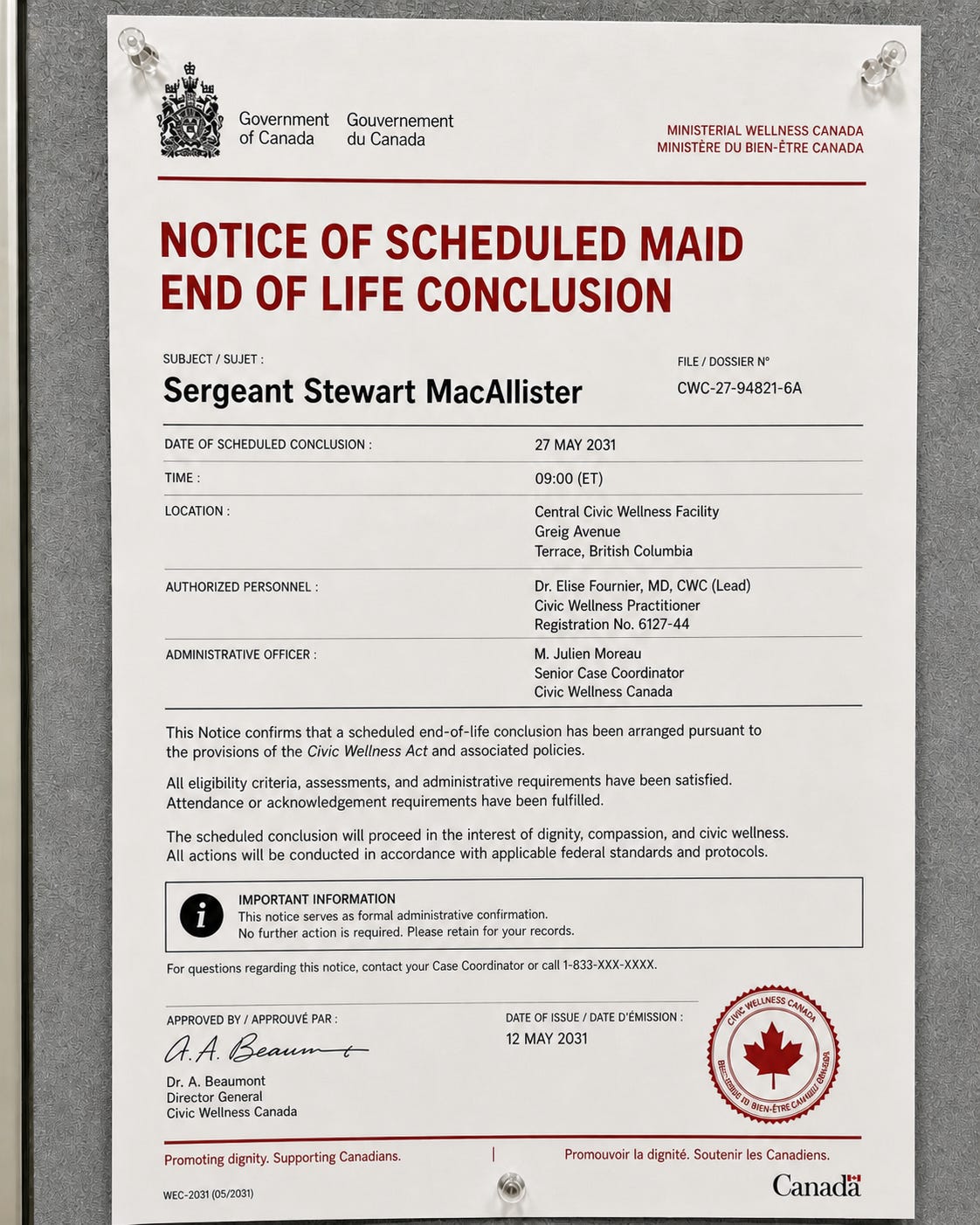
Now his fiftieth birthday approached like a scheduled appointment.
At home, his wife Claire folded laundry with mechanical care. Their house overlooked the valley, cedar siding weathered silver. On the kitchen wall hung a photograph from fifteen years ago, Stewart in full red serge, Claire at his side, their two children between them. The children were taller now. Liam was seventeen, studying Civic Systems in Prince George. Emma was fourteen, already discussing her Contribution Pathway assessment with counsellors.
Claire had always been proud of him. The uniform. The steadiness. The way people’s shoulders relaxed when he entered a room.
Now she watched him as if memorizing angles.
“You do not have to be brave at home,” she told him one night, her voice low so the house monitors would register nothing irregular.
“I am not afraid,” he said.
It was true in a way. Fear implied unpredictability. His end was scheduled for 0900 hours at the Terrace Civic Wellness Centre, formerly First Baptist Church. There would be a brief commendation, consisting of a recorded message from the CO. Then, sedation. A final biometric confirmation.
Efficient. Humane.
Emma stopped asking questions. At first she had searched the public database for exceptions. Distinguished Service extensions. Medical deferments. There were none. The law was elegant in its equality.
One evening she found him polishing his boots.
“Dad,” she said, standing in the doorway. “You are healthy.”
He looked up at her. She had Claire’s eyes.
“Yes.”
“They say this is about dignity.”
“It is,” he answered carefully. “We give our lives in different ways.”
Her jaw tightened. “But you already gave yours.”
He did not respond. She was right, of course. Countless missed birthdays and Christmases, not to mention probably hundreds of interrupted family gatherings for on-call emergencies.
At the detachment, constables avoided his gaze when the scheduling notice arrived. It was embossed with the federal crest. Stewart signed the acknowledgment without hesitation.
Constable Singh lingered after briefing one afternoon. He was new to Terrace, having been transferred in from Surrey just a month ago.
“Sarge,” Singh said, and then paused. “My father is fifty two.”
Stewart nodded. “Then he has already completed his cycle.”
Singh swallowed. “Yes, sarge.”
There was nothing more to say.
The town organized a final community walk. No banners. Public displays of grief were considered destabilizing. But people lined the sidewalks along Keith Avenue as Stewart walked in uniform from the detachment to the Wellness Centre for his pre Transition orientation. They did not cry loudly. They stood with hands clasped, hats removed. In a way, the silence felt heavier than protest would have.
He saw the Halvorsens near the bakery. The school principal. The mayor again, pale and rehearsed. A child broke from her mother and pressed a small carved wooden horse into Stewart’s hand.
“For you,” she whispered.
He crouched and thanked her. His knees did not ache. His heart was strong. He could feel it, steady in his chest.
Inside the Wellness Centre, the old stained glass had been replaced with frosted panels. Light entered without colour. A mural on the far wall depicted abstract figures ascending into brightness. No crosses. No symbols. A technician explained the process with gentle efficiency. Stewart listened as if receiving a weather report.
On his last night at home, the family ate salmon and roasted potatoes. It was Stewart’s favourite meal. Claire set the table with their good dishes. They did not discuss tomorrow. They spoke about Liam’s exams. About Emma’s art project. About the early snow predicted on the mountain passes.
After dinner, Stewart stepped outside alone. The air was sharp with pine. Terrace lay quiet beneath the stars. He had spent decades protecting this place from chaos, from harm, and the citizens from each other. He had believed that obedience preserved community. That sacrifice maintained order. He had told frightened citizens that the laws were necessary. That unity required surrender.
Now the unity required him.
At 0855 hours, the next morning, the Wellness Centre filled with approved attendees. Claire held his hand. Emma’s fingers trembled in his other. Liam had arrived on the late bus and stood tall, jaw clenched, wearing his father’s old detachment jacket.
The CO’s recorded voice praised Sergeant Stewart MacAllister for exemplary service and unwavering compliance. A model citizen. A pillar of optimized society.
Stewart looked out at the faces of Terrace. People he had rescued. Guided. Corrected. Comforted.
He felt no anger. Only a vast and hollow clarity. Order had been maintained.
At 0900 hours, the technician asked for final confirmation.
Sergeant Stewart MacAllister, age fifty, citizen in good standing, nodded.
Outside, the river continued its course through the valley, indifferent and enduring. In the days that followed, the town would adjust. Another sergeant would wear the uniform. Another birthday would come.
Order had been maintained.
That was very well written, provoked many emotions, sorrow, empathy, anger. A lot of anger. The way our country is going, it seems a bit too prophetic. Praying that will never come to pass..thank you for your creative way of making people think.
Outstanding! But are you sure it's fiction?