The Lullaby of Self-Correction
From the Loyalists to the Freedom Convoy, Canada has trusted the system to correct itself, even when the system is the problem.

Have you ever wondered why some countries are born in revolution, while others come to see restraint as a national virtue?
I suspect that nations continue in the way they were raised.
If a country is born out of conflict and revolution, it is likely to carry some memory of that into adulthood. It learns that power can be resisted, authority can be defied, and obedience is not always a virtue.
But if a country is born into a relationship where obedience is treated as maturity, and patience as wisdom, it may grow into something else entirely.
Canada is an unlikely nation of opposing parts, cobbled together through a marriage of necessity that somehow outlasted the necessity. It was not born in rupture. It was raised in continuity, restraint, compromise, and process.
That inheritance has consequences.
It may produce an orderly rule-follower: the kind of country that waits, follows appeals and process, and keeps trusting the machinery long after the moment has called for refusal.
A Loyalist Wagon Heading North
As the thirteen British colonies declared independence from Britain and began their bloody march toward self-rule, many British Loyalists packed their belongings and headed north to the predictable safety of British North America.
For them, revolution looked like order collapsing and mobs replacing law. The promise of self-rule seemed more uncertain and chaotic than the familiar structures of the Crown.
That is one of the great differences between the American and English Canadian founding memory.
America’s founding memory is a tea chest in a harbour.
English Canada’s is a Loyalist wagon heading north.
For the American revolutionaries, revolution was opportunity. They saw a chance to throw off the distant imperial authority of the Crown with its arbitrary rule, taxation without consent, and political maturity denied. Resistance was not merely permitted; it became the proof of seriousness. A people who wished to be free had to be willing to break with the parent and stay out past curfew.
And so our two nations came to be. The United States of America, born with a revolutionary suspicion of distant power. And Canada, raised to follow process, seek approval, and wait for the proper office to open.
This is where things quietly start to make sense.
When Canada is confronted with a crisis of moral or political importance, it does not usually meet it with willpower and destiny. It hands it over to procedure. It studies it, manages it, files it, reviews it, and turns it into a final report. Then people generally accept the result and move on with life. If they grow weary of the way things are being managed, they punt out the governing party and vote in the other team.
When the pendulum swings too far, the usual reassurance is that it will swing back on its own. The courts will sort it out. The inquiry will reveal what went wrong. The next election will fix it.
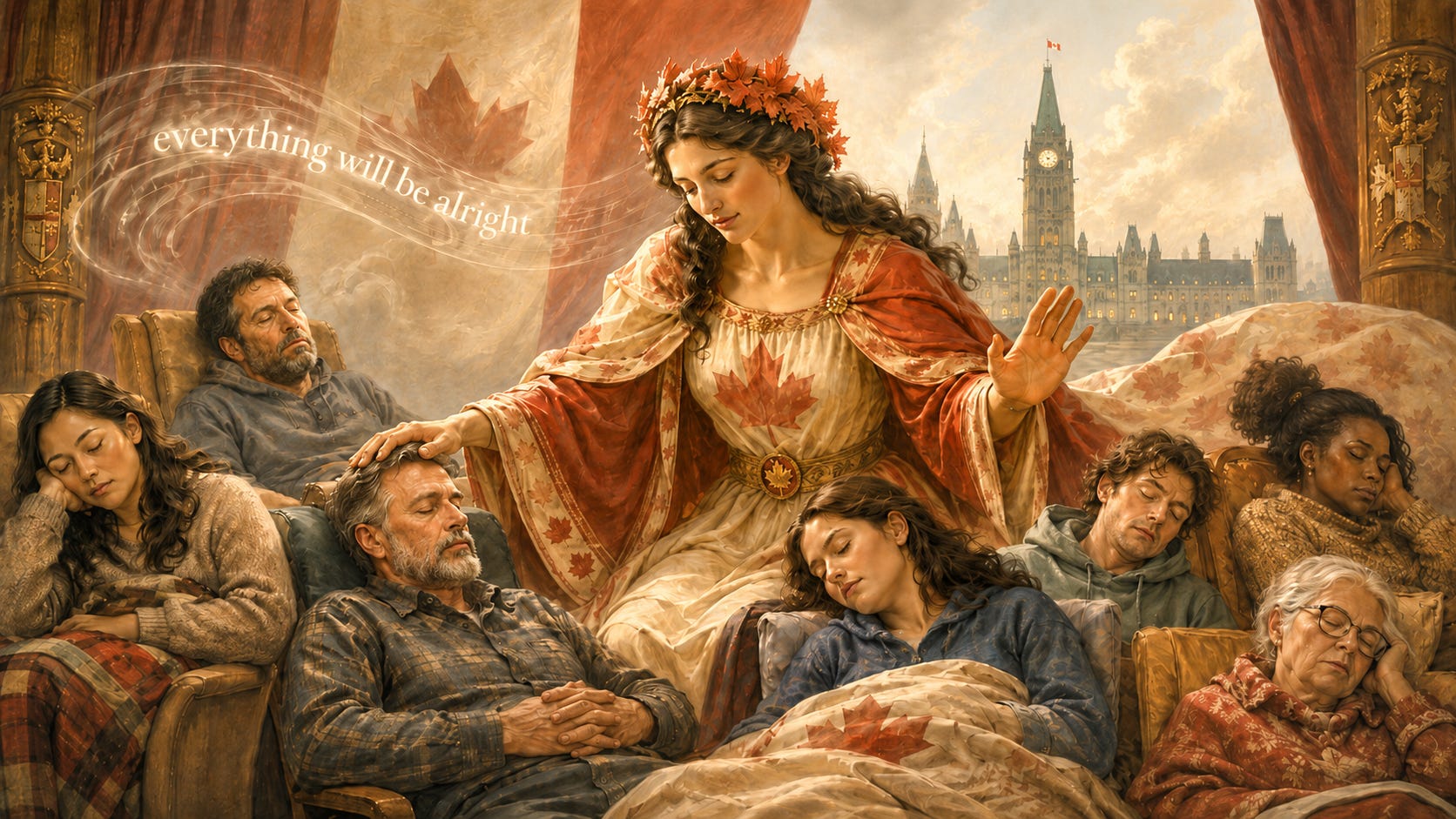
That is what I like to call the lullaby of self-correction.
It is not cowardice. It is the belief that the system eventually corrects itself.
The Revolution Canada Filed Into a Report
Nearly thirty years before Confederation, what would become Canada had its first real revolutionary moment.
In 1837 and 1838, rebellion broke out in both Upper and Lower Canada. These were not minor complaints over bad manners at the colonial office. There were real grievances behind them: governments that answered colonial authorities instead of the people, small circles of insiders who treated public office like private property, patronage networks that rewarded loyalty over merit, and elected assemblies that could argue, complain, petition, and pass resolutions, but could not truly govern.
Those grievances had different names depending on which colony you were standing in.
In Upper Canada, William Lyon Mackenzie and his Reformers railed against the Family Compact, that tight little club of officials and loyalists who seemed to have mistaken public office for private inheritance.
In Lower Canada, Louis-Joseph Papineau and the Patriotes pushed against the Château Clique and a colonial system that left French-Canadian political power boxed in by appointed authority.
These rebels looked at the existing order and concluded that petitions and polite speeches were no longer enough. If the system would not listen through the proper channels, they would force the issue outside them.
But here is the Canadian turn.
The rebellions were suppressed, the imperial system held the line, and the rebels were defeated, punished, or absorbed into memory. Then Britain sent Lord Durham to investigate what had gone wrong.
To be fair, the report was not meaningless. The Durham Report helped push British North America toward responsible government. It helped move the colonies away from rule by appointed insiders and toward a system where the executive had to answer to the elected assembly.
That was no small accomplishment. But it also went deeper than that.
Canada did not turn rebellion into a founding memory of rupture. It turned rebellion into an administrative lesson. It could have remembered 1837 as the moment the people rose up and forced the country to become something closer to their own will.
Instead, the story became this: the people rose up, the state restored order, a responsible man was appointed to study the problem, and a measure of reform arrived later through the proper channels.
Even Canada’s revolution had to be reviewed, summarized, filed, and converted into policy.
That is why the Rebellions of 1837–38 are so useful for understanding the Canadian mind. They gave Canada just enough rebellion to prove it had grievances, but not enough rupture to make rebellion part of its national character.
The system bent, but it did not break. And because it bent, Canadians learned to trust the bending.
Rebels at the Edge of the Map
Métis leader Louis Riel was another well-known Canadian resistance figure. He was a bit of an unusual character, and probably hard to manage from an administrative point of view. He was Métis, Catholic, French-speaking, and from the West. He did not fit neatly into the category the government probably would have preferred to put him in.
Riel and his people lived in the Red River Settlement, within the huge territory known as Rupert’s Land. The Hudson’s Bay Company had long held chartered control over that land, but when Canada moved to absorb it, the Métis of Red River were not treated as a people whose consent had to be won. They were treated more like a problem to be organized.
Ottawa sent surveyors, expected new settlers to arrive, and prepared to bring the territory under Canadian control.
This did not sit well with Riel or the Métis.
They formed a provisional government, forced negotiations with the federal government, and helped bring Manitoba into Confederation through the Manitoba Act of 1870, with promises meant to protect Métis land, language, religion, and rights.
Riel would eventually be remembered as the founder of Manitoba, but at the time he was not very popular with the federal government. After the Red River saga, and especially after the execution of Thomas Scott by the provisional government, he became a hated figure in much of English Canada, both a political problem and a legal target. Riel eventually went into exile in the United States.
But the Métis did not receive the Manitoba settlement they had hoped for. The land promises were delayed, mishandled, and tangled in bureaucracy. New settlers arrived, and the old Red River world changed. Many Métis families eventually moved farther west into what is now Saskatchewan and Alberta, still trying to have their land and rights recognized.
But even there they ran into resistance.
Petitions moved slowly, and Ottawa was far away. Grievances accumulated and formal remedies failed to arrive. Eventually, with negotiations going nowhere, Métis leaders once again called on Riel for assistance.
During the North-West Resistance of 1885, Riel and the Métis made another ill-fated attempt at asserting their land and rights. Ottawa responded in force. Canadian troops were sent west, and the Métis suffered a devastating defeat at the Battle of Batoche.
Riel surrendered, was tried for treason, and was eventually hanged in Regina, at the North-West Mounted Police barracks.
The same pattern played out again with Riel and the Métis. Ottawa met resistance with force, restored order, and dealt with the rebel. The Métis carried the consequences while the rest of the country moved on.
Only later did Canada begin to soften the memory. Riel was no longer just a troublemaker. He became the founder of Manitoba, a defender of Métis rights, and eventually the kind of historical figure the country could safely honour. Ottawa can afford to celebrate rebels once they are safely dead, defeated, or reduced to a heritage plaque.
The Canadian Pattern: Contain, Study, Absorb
By now, the pattern should be visible. Canada does not usually know what to do with rupture in real time. It does not look at disorder and think, “Perhaps the people are trying to tell us something.”
First, it responds. Then it contains. Then, once the situation has been brought back under control, it studies the matter and publishes the report.
The Winnipeg General Strike followed the same rhythm. In 1919, more than 30,000 workers walked off the job in one of the largest labour actions in Canadian history.
For the workers, it was a fight over wages, working conditions, and the right to bargain collectively. For the business class and political authorities, it appeared to be something far more dangerous: mass disorder, class conflict, maybe even revolutionary contagion.
So the state moved. Strike leaders were arrested, force was used, and order was restored.
In time, Winnipeg was absorbed into the respectable Canadian labour story. Once the streets were quiet and the danger had passed, there was room to study it, commemorate it, and place it safely into the national archive as an important event in the long march toward workers’ rights.
The October Crisis showed another version of the same instinct.
This time, the facts were different, as was the moral terrain. The Front de libération du Québec (FLQ) was not a protest movement. It was a violent separatist group that wanted Quebec to break from Canada and used bombings, kidnapping, and murder to force the issue. In 1970, the crisis reached its peak when the FLQ kidnapped British trade commissioner James Cross and Quebec labour minister Pierre Laporte. Laporte was later found dead. Any serious country would have had to respond.
But Canada’s response still revealed something important about the reflex of the state. Faced with fear, separatism, violence, and the possibility of wider insurrection, Ottawa reached for emergency powers. Civil liberties were suspended, the machinery of order expanded quickly, and the country accepted extraordinary measures because the situation had been presented as an extraordinary threat.
Winnipeg and the October Crisis were vastly different events. A general strike is not a kidnapping, labour unrest is not political violence, and a protest movement is not the same thing as an armed separatist cell.
But the Canadian rhythm remains familiar.
A report is written, a commission is struck, a history is produced, and eventually the whole thing becomes something Canadians can discuss calmly once the danger has passed.
The point is not that governments should never restore order. Of course they must. No serious society can survive without law, public peace, and the basic authority to prevent violence, intimidation, and chaos.
The deeper question is whether a people still possess the civic muscle to resist government power when the government no longer serves the country, but begins managing it into submission.
A free nation needs some living memory of refusal. Some inherited instinct that says: there is a line here. You may govern, but you may not own us.
That is where Canada’s history becomes uncomfortable.
When a nation has never had its clean revolutionary moment, when its political identity has been built around loyalty, order, reform, and institutional correction, how does it know when correction is no longer coming?
How does it know when patience has become obedience, or when a legitimate desire for order has quietly hardened into a habit of control? At what point does trust in institutions cease to be a civic virtue and become an inability to recognize that those institutions have exceeded their proper limits?
These are not abstract questions. They form the bridge from Riel to the modern era, because they point to a recurring feature of Canadian political life: resistance is often treated as disorder before it is understood as dissent, and judged as a threat before it is considered as a warning.
Soft Despotism With a Canadian Accent
This is where Alexis de Tocqueville starts to sound uncomfortably modern.
He did not think democratic societies would necessarily fall under obvious tyrants. The danger, as he saw it, was not always a man in uniform barking orders from a balcony. It was something softer, more paternal, and more administrative.
A power that does not brutalize the citizen, but rather manages him.
The kind of power that watches over him, advises him, regulates him, relieves him of certain burdens, and eventually trains him to accept a smaller and smaller range of action as normal. The citizen is not dragged into obedience. He is guided there by people who insist they are only trying to keep him safe, informed, included, protected, and properly governed.
That is the Canadian danger: not jackboots marching through the streets or a dictator kicking down doors, but something that is quieter and easier to overlook. It emerges through emergency orders justified as temporary necessities, through the language of public safety and professional regulation, through increasingly narrow boundaries around acceptable speech, and through experts who patiently explain that your objections are misguided, irresponsible, or proof that the system requires even more oversight.
None of these things look dramatic on their own. That is the whole point. Soft despotism rarely announces itself as despotism. It presents itself as management. As care. As the reasonable thing serious people do when unreasonable people are making life difficult. This is where Canada’s correction begins to betray itself.
Citizens trained to trust process may assume every new process is legitimate. Those accustomed to valuing order may struggle to notice when order has become control. And a society conditioned to wait for institutional correction may keep waiting long after the institutions themselves have become part of the problem.
That is the lullaby working as designed.
The government goes too far while speaking the language of safety. The bureaucracy expands under the banner of service. Regulators impose discipline in the name of professional standards. Banks restrict access in the language of compliance, while those who shape the public square justify limits on expression as harm reduction. When citizens object, they are often met by an expert class that treats dissent not as a warning sign but as evidence that stronger oversight and tighter controls are needed.
Canadian despotism will not arrive with a boot through the door. It will arrive with forms, policies, panels, and a very concerned official explaining that it is all being done for the public good.
It won’t kick the door down. It will just narrow the hallway.
The Canadian Obedience Reflex
This is where the Canadian weakness becomes personal.
It is easy to talk about the Loyalists, Riel, the October Crisis, and Tocqueville as if they belong safely in the distance. History is comfortable that way. It lets us study our national character without admitting that we still live inside it.
But the Canadian obedience reflex is not buried in the past. It is alive in the room.
Canada has an obedience culture disguised as politeness. The Canadian citizen is taught to see virtue in restraint and deference, to assume that those in authority probably know better, and to regard open confrontation as a sign of poor character. He is taught to wait his turn, lower his voice, respect the process, follow the signage, trust the expert, and not make life difficult for the person behind the counter.
Most of the time, this produces a peaceful society. Canadians line up. They apologize, avoid scenes, and keep public spaces relatively orderly. They do not want politics to become a blood sport, and there is something decent in that.
But every virtue has its shadow.
The same instinct that makes a society peaceful in normal times can make it dangerously compliant in abnormal times. A people trained to be reasonable can become very easy to manage once “reasonable” is defined by those who hold institutional authority and cultural influence.
Instead of asking whether something is lawful, people begin asking how to avoid making a scene. Worries about whether the government has crossed a line give way to worries that speaking honestly might cost them their job. And where they once asked whether a claim was true, they start calculating what they are still permitted to say out loud.
That is not cowardice in the simple sense. It is the result of long social reinforcement. It is what happens in a country that has long rewarded compliance with moral respectability and punished refusal with social embarrassment. The great Canadian fear is not tyranny. It is being seen as difficult, extreme, unreasonable, or even embarrassing.
This is why the Covid years cut so deeply into the Canadian psyche. Many people knew something was wrong. They knew the rules were inconsistent and that the “safe and effective” claims were overconfident. They also knew that the punishments were cruel, that families were being divided, workers were being coerced, churches were being watched, businesses were being destroyed, and private doubts were becoming professionally dangerous.
But they stayed quiet because the cost of speaking became too high. The country had built a social machine in which dissent could be made to feel not merely incorrect, but shameful. To object was to risk being placed outside the circle of decent people. And Canadians are trained from childhood to fear that exile.
So they waited. They waited for someone else to speak first, for institutions to correct themselves, and, most of all, for permission to say what they already suspected.
That is the lullaby at the level of the individual citizen.
The Canadian sin is making a fuss before the government has finished explaining why the fuss is irresponsible.
The Convoy and the Crack in the Script
The Freedom Convoy was not a revolution in the classical sense. It was nothing like 1776 or 1837, and it bore no resemblance to Riel forming a provisional government at Red River. It was, however, a mass refusal. And in Canada, that was almost revolutionary.
The Convoy broke the Canadian script. People were supposed to complain politely, trust the process, and vote later. That is how the system prefers dissent to behave: orderly, delayed, procedural, and easy to absorb.
Instead, ordinary Canadians went to Ottawa and refused to leave. That response revealed a great deal.
The echo of the October Crisis was hard to miss. Once again, extraordinary measures were justified because the situation had been presented as an extraordinary threat. But this was not the FLQ. No one had been kidnapped or murdered, and there was no armed separatist cell waiting in the wings.
There were street parties, bouncy castles, volunteers feeding people, a lot of honking, and ordinary Canadians who had decided that waiting quietly was no longer enough.
Yet the machinery of emergency still came out.
The state did not merely disagree with them. It escalated. Emergency powers were invoked, financial pressure was used, and protesters were framed not merely as citizens in dispute with government policy, but as a national threat. Bank accounts were frozen before the appeal was heard. Reputations were damaged before the report was written. Dissenters were branded before the government was told it had gone too far.
The legal reckoning only confirmed the point: two federal courts found that the government had crossed the line, including breaches of Charter rights. Canadians were told the emergency was the protesters, but the courts made clear that the emergency was also the government.
When the Kitchen Table Is Freer Than the Public Square
Natan Sharansky offered a simple test for the difference between a free society and a fear society: can a person say in public what he says in private? That question cuts closer to Canada than many people would like to admit.
How many Canadians speak more honestly at the kitchen table than they do at work? How many will say things around trusted friends or in a private chat that they would never say publicly?
You can feel the change when ordinary people begin to say the safe thing in public while saving their honesty for kitchens, truck cabs, and private conversations. A society does not need to arrest everyone to train speech. It only needs to make honesty expensive enough that normal people begin censoring themselves long before the law requires it.
That habit becomes part of the lullaby. Everyone knows more than they say, waits for someone else to say it first, and hopes the system will correct itself so they do not have to pay the price of honesty. Over time, private caution becomes part of the public culture. When the kitchen table becomes freer than the public square, something has already shifted. The citizen may still be technically free, but he has begun to rehearse obedience.
Preparation Is Not Panic
This is not a call for revolution, nor a plea to flee tomorrow. It is simply a call to stop mistaking preparation for paranoia.
For many Canadians, the idea of building an exit option still feels disloyal. Canada was meant to be the final safe harbour, the place people flee to, not from. Generations were raised to see ourselves as the lucky ones who had already arrived, not as people who might one day need an escape route. That inherited sense of permanence makes Plan B feel almost like betrayal.
But optionality is not disloyalty. It is insurance. A second residency, flexible income streams, international banking access, and a realistic landing plan are not signs of panic. They are proof that you have chosen responsibility over helplessness.
The courts may eventually rule. The inquiry may publish its report. Historians may one day acknowledge what happened. None of that changes the fact that your life unfolds in real time, before the official verdict arrives and before polite society quietly revises its story. When the comforting lullaby stops working, responsible people build options.

If you’re ready to move from waiting to preparing, start with the Plan B Starter Pack.
If you want more practical guidance, unfiltered analysis, and early access to new options as they emerge, I invite you to subscribe below.
Stay free,
Exiled Mountie
Canadians believe we can compromise our way out of anything, but if they knew what happened to Canadian rebels - the ones punished with humiliation rituals - they'd realize we aren't compromising at all. We're capitulating because we have no other choice.
Great work and good article! 🇨🇦🍁