The Death of Plain Speech
How a single word choice quietly turned a human right into an administrative category
Canada loves to think it has free speech, right up until someone says something inconvenient.
On paper, we are still sold the story of a robust twentieth-century democracy where the right to speak freely is “enshrined” in the Charter of Rights and Freedoms. In practice, Ottawa keeps bolting on more guardrails so no one’s feelings get bruised and the wrong opinions do not spread too far.
Here is the interesting part: the Charter does not actually use the plain old phrase “freedom of speech.” It protects “freedom of thought, belief, opinion and expression.”
That is not an accident.
Speech is human. It comes out of your mouth and your conscience. You use it with the neighbour standing in front of you, from a pulpit, around a dinner table, on a protest sign, and in the public square. It is direct and personal.
Expression, on the other hand, is the language of courts, tribunals, balancing tests and endless Section 1 limitations. It is a legal category that can be weighed, interpreted, restricted, and justified in the name of a “free and democratic society,” whatever the government decides that means this week.
The Supreme Court made this clear in the Irwin Toy decision. Expression is defined as any activity that conveys or attempts to convey meaning. That is deliberately broad: it covers speech, writing, advertising, symbols, protests, and more. The Court even tied it to lofty values like truth-seeking, democratic participation, and individual self-fulfillment.
But here’s the catch: once something qualifies as “expression,” it doesn’t get a free pass. It immediately runs into Section 1 of the Charter, which says every right is subject to “reasonable limits prescribed by law” that can be “demonstrably justified in a free and democratic society.”
That is where the Oakes test enters the room.
The government must show that its objective is pressing and substantial, that the limit is rationally connected to that objective, that it minimally impairs the right, and that the benefits outweigh the harm.
In plain English: your expression is protected… until the system decides it isn’t.
The word ‘expression’ has drifted far beyond its original meaning. It started life in the Charter as a protected freedom. It now also appears as ‘gender identity or expression’, a protected ground under the Canadian Human Rights Act. Speech is increasingly treated as an administrative category rather than a raw human right.
In Canada, the citizen speaks. The state translates it into “expression.” Then it runs the whole thing through the reasonable-limits machine to determine how much freedom you’re allowed to keep.
That single linguistic shift, from “speech” to “expression,” tells you more about how the country actually works than any political speech ever could.
But the problem runs deeper than law. The Charter’s wording reflects a deeper philosophical downgrade: the modern state no longer treats speech as a fundamentally moral act. It treats it as “expression:” something to be regulated, weighed, and managed.
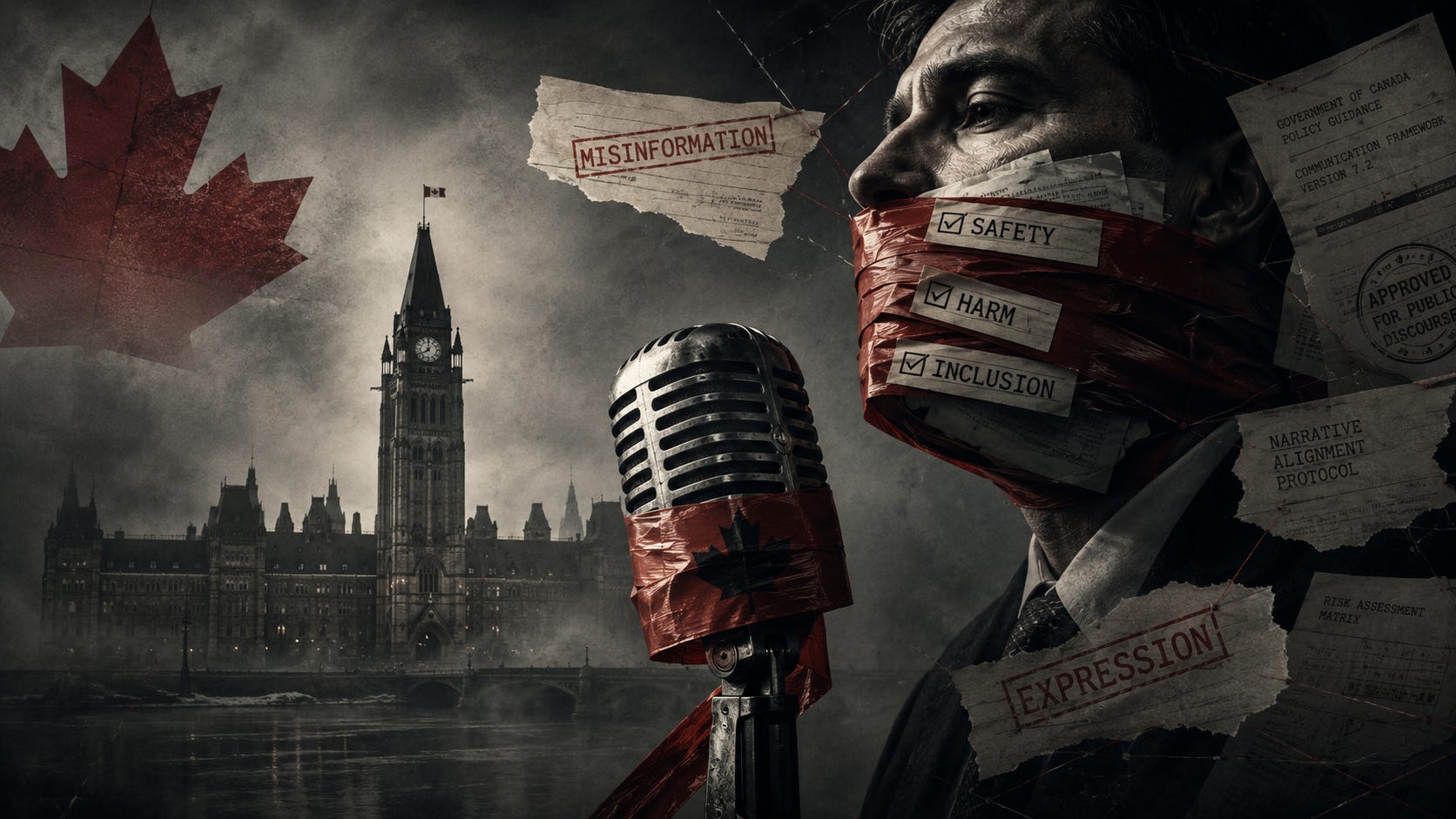
Speech Is Moral Before It Is Legal
Scripture treats speech as something far more serious than a legal category to be balanced by the courts. It presents speech as immensely powerful, something that carries real weight in the moral order of the world.
We are told that human beings were created in the image of God. And God Himself spoke the world, and everything in it, into existence. “Let there be light,” and there was light. Creation itself began with spoken word.
Proverbs 18:21 puts it plainly: “Death and life are in the power of the tongue, and those who love it will eat its fruit.”
The tongue, Scripture warns, is a restless evil, full of deadly poison. It can bless or curse, heal or wound, expose evil or conceal it, build up or tear down. Speech is witness. It is confession. It can call things by their right names or deliberately rename them.
One of the clearest marks of a corrupt age is the deliberate inversion of reality: “Woe to those who call evil good and good evil, who put darkness for light and light for darkness” (Isaiah 5:20).
That verse is not ancient poetry for Sunday school. It is a diagnostic for our age. When a society begins punishing the plain naming of things while rewarding the renaming of them, it has stopped arguing about policy and started waging war on truth itself.
Speech, in the older moral sense, is not neutral. It is one of the primary battlegrounds between good and evil. That is why it should never be casually handed over to bureaucrats, tribunals, or political managers. It is powerful enough to wound, yes, but also powerful enough to expose corruption and refuse official lies.
Orwell and the Corruption of Language
George Orwell understood this mechanism with cold clarity. In 1984 he showed the final stage: War is Peace. Freedom is Slavery. Ignorance is Strength. But the more practical diagnosis came in his essay Politics and the English Language.
Orwell argued that sloppy, euphemistic, and ideologically corrupted language is not merely a symptom of bad politics, it is one of its primary tools. When language becomes vague, inflated, or deliberately misleading, it becomes far easier for power to manipulate thought itself. He wrote that political language is designed “to make lies sound truthful and murder respectable, and to give an appearance of solidity to pure wind.”
The process is brutally simple:
First, rename the thing.
Then moralize the new name.
Then make refusal to use the new name suspicious or dangerous.
Canada has become remarkably skilled at this.
Take the country’s favourite slogan: “Diversity is our Strength.” On the surface it sounds harmless, even uplifting. In practice, it functions as a shield for state multicultural ideology. The phrase assumes what it should be required to prove: that multiplying differences automatically strengthens the country.
But Canada’s older wisdom understood something different. United we stand, divided we fall. A country cannot survive on permanent fragmentation. It needs a shared language, shared loyalties, shared moral assumptions, shared memory, and a common civic culture strong enough to absorb newcomers into something recognizable.
Diversity without assimilation is not strength. It is managed division: the oldest political tactic in the book, dressed up in modern language. Keep the people divided and you keep them easier to rule.
That is the Orwellian trick. The state takes a force that can weaken social trust when left unmanaged, renames it “strength,” and then treats anyone who notices the contradiction as intolerant. The slogan does the work before the argument begins.
This is the alchemy of modern political language. It does not simply lie. It renames reality, cloaks the new name in moral virtue, and then uses institutional pressure to enforce the new vocabulary. Orwell saw this coming: the corruption of language is a form of ideological subversion. Once people accept the manipulated terms as normal, they have already conceded half the battlefield.
In Canada, this is not abstract theory. It is daily administrative reality. The system rarely says, “We are restricting speech.” It says, “We are protecting vulnerable groups from harm.” It rarely says, “We are enforcing new ideological norms.” It says, “We are promoting inclusion and diversity.” The name is always the alibi.
The Name Is the Alibi
Look at the pattern.
The proposed Online Harms Act, Bill C-63, was never called the Online Speech Regulation Act. It was framed as protecting vulnerable people from harm, complete with proposals for a Digital Safety Commission and Ombudsperson. The moral framing was built into the title before the debate even began.
Bill C-16 did not simply add new legal protections. It added “gender identity or expression” to the Canadian Human Rights Act as prohibited grounds of discrimination. The state did not merely create a new category, it helped formalize an entirely new vocabulary of personhood inside federal human-rights law, making certain forms of speech and conduct around that vocabulary legally actionable.
Even the national anthem had to be linguistically corrected. In 2018 the English lyrics of O Canada were changed from “in all thy sons command” to “in all of us command” to make it gender neutral. The new version is not only weaker poetically, it is noticeably awkward and grammatically strained. Native speakers do not naturally talk that way. But correctness had to yield to ideology. When language must serve political goals above all else, even the national hymn is not allowed to stand if it offends the new sensitivities.
Medical Assistance in Dying (MAID) turned assisted death into a bureaucratic acronym and then into a routine medical procedure. “Safer supply” reframes giving pharmaceuticals to drug addicts as compassionate harm reduction instead of a policy of managed dependency.
“Sustainable jobs” and the old “price on pollution” dress up industrial policy, higher costs, and regional economic disruption in the language of environmental virtue.
In each case the name does the heavy lifting. The policy is presented as compassionate, progressive, or necessary before anyone can ask whether it is wise.
The Consequences Machine
This is where the real regime reveals itself.
Canada still has freedom of “expression” on paper. What it increasingly lacks is freedom from consequences for plain speech. The slogan “freedom of speech does not mean freedom from consequences” sounds reasonable on the surface. Sometimes it simply means other people may criticize you, mock you, or refuse to associate with you. That is fair game in a free society.
But increasingly it means something darker: you may speak plainly, and then the distributed punishment system may come for your job, your professional licence, your grant funding, your platform, your bank account, or your social standing. The state does not have to censor every sentence when workplaces, universities, platforms, and professional bodies will do the enforcing for free.
Canada already crossed that line during the Freedom Convoy.
Under the Emergencies Act financial measures, the state showed that political protest could be met not only with police lines and media denunciation, but with financial pressure. Bank accounts could be frozen. Financial information could be shared. Access to one’s own money could become contingent on whether the state viewed one’s participation as acceptable.
That was not a Twitter conspiracy theory. It actually happened.
And in 2026, the Federal Court of Appeal confirmed that the government’s invocation of the Emergencies Act was unreasonable, beyond its legal authority, and infringed Charter rights.
The lesson was not subtle. In modern Canada, the wrong kind of political expression can become a financial risk.
The result is the quiet, widespread self-censorship that now defines much of Canadian public life. People still have the formal right. They simply learn that exercising it carries a price most eventually decide is too high.
Plain Speech as Resistance
A free people must be able to speak freely.
This is not a minor procedural issue. It is the heart of the matter. When a society can no longer tolerate plain speech, when every uncomfortable truth must be filtered through euphemism, renamed, or softened so it does not offend the official sensitivities, it has already lost something essential.
Frederick Douglass understood this. He called the right to speak one of the great dreads of tyrants, because once a man can name what he sees, the lies begin to crumble.
George Orwell put it even more sharply: “If liberty means anything at all, it means the right to tell people what they do not want to hear.”
And Scripture is uncompromising on the point. Truth is not a negotiable category to be balanced against “harm” or “inclusion.” Evil must not be renamed as good. Darkness must not be called light. The tongue that calls things by their right names is not an inconvenience to be managed, it is a moral necessity.
A free country needs more than a legal category called “expression” that can be weighed, limited, and processed through Section 1 balancing tests. It needs citizens with the courage, the vocabulary, and the simple moral permission to say true things plainly, even when those truths are unpopular, even when they offend the prevailing consensus, and even when they make the system uncomfortable.
Canada still has freedom of expression on paper. But in real life, people are learning to speak carefully, vaguely, and with one eye on the consequences. That is the quieter erosion: the formal right remains, while the courage to use it slowly dies.
The battle is no longer only about what the Charter protects. It is about whether Canadians will insist on keeping the ancient, stubborn, and deeply human right to call things by their proper names.
Because once a people surrender that, no amount of legal “expression” will ever replace it.
Stay free,
Exiled Mounty
If this piece resonated with you, the real question is what you’re going to do about it.
Talking about the problem is easy. Building actual options so you’re no longer trapped by one country, one system, and one set of managed speech rules is harder, but far more useful.

That’s why I put together The Free Plan B Starter Pack: a short, no-nonsense field guide for Canadians who want to start restoring optionality before pressure makes the decision for them, covering the first practical moves around documents, country shortlisting, a 90-day plan, and the mindset shift required to stop waiting for the old Canada to come back.
Get the Free Plan B Starter Pack here:
👉 exiledmounty.com/plan-b-starter-pack.html
"Here is the interesting part: the Charter does not actually use the plain old phrase “freedom of speech.” It protects “freedom of thought, belief, opinion and expression.”
In actual fact, we don't have these protections any longer. In BC, unless you 'believe' men can be women and women can be men, you will be fined and probably given jail time. Wrong beliefs are not allowed. During the COVID scam, I refused the jab based on my Christian beliefs (they use fetal cells in vaccines and in the covid case, mRNA technology which was experimental) and I also had a valid health reason for refusing (including a doctor's letter) and yet I was still ostracized, called names, a tin foil hat wearer, selfish, etc. I made a human rights claim (just to test the system) and of course it was denied. So no, we do not have those protections either. My opinion and honest belief is that our Creator made a man and a woman for a specific purpose. Sorry...but a male cannot be a female or a female a male. Nor can a child of 12 make that kind of decision. Their bodies are being butchered and their lives destroyed.
If rights can be taken away they are privileges and not rights. I think we found this out during the Covid insanity. You aren't being forced to take the gene therapy but if you don't you can't work, eat at a restaurant, or get on an airplane. You have the right to donate your own money to a lawful cause but when we decide we don't like the cause we can freeze your bank account without due process. Now it's clear we don't have property rights when activist judges can override fee simple in favour of aboriginal property rights.
Our Charter of Rights and Freedoms is not fit for purpose as your post makes clear. I used to say things like, "The government would never (fill in the blank)." Now I say they would and they will.