Mexico as a First Flag: The Most Practical Place to Begin
Your first Plan B does not have to be exotic, expensive, or permanent. It just has to be useful.

Most Canadians understand Mexico as a place to vacation. This generally means escaping the deep cold of mid-February and going to an all-inclusive resort in Cancún, stuffing your face with free food all day and sporting a sunburn that might make locals confuse you for a freshly boiled lobster.
But the minute you suggest Mexico as a serious Plan B option, people think you’ve followed the rabbit down too many YouTube conspiracy holes.
It should not be that way.
Mexico is not just a vacation country. It is one of the most practical first flags available to Canadians and freedom-seekers who are beginning to think seriously about jurisdictional diversification.
And on that front, Mexico makes a lot of sense.
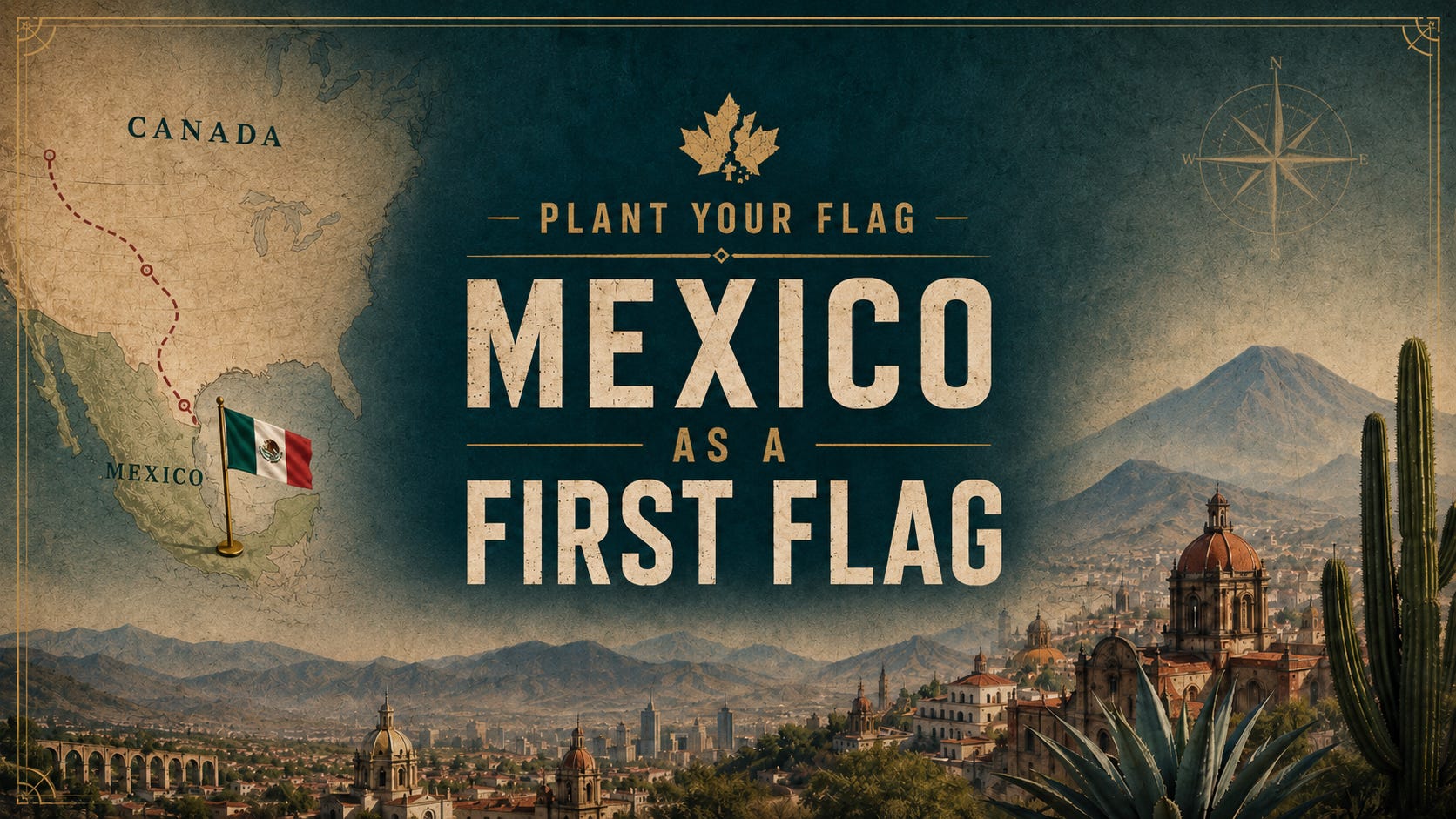
It’s Close to Home
One of the biggest advantages of Mexico is geography. This sounds obvious, but it should not be dismissed.
If you are building a practical Plan B, distance is important. A country can look perfect on paper, but if getting there requires three flights, two layovers, a lost suitcase, and a spiritual crisis, you are less likely to ever use it.
From major Canadian cities, Mexico is very manageable. You can leave Canada in the morning and be eating tacos al pastor in Mexico City by dinner.
That kind of access changes the whole process. Mexico is close enough that you can test it gradually instead of turning the decision into one dramatic leap. You can spend a couple of weeks in one city, come back, think about it, then try another. Over time, the country stops being an idea on a screen and starts becoming something practical: neighbourhoods you have walked, doctors you have looked into, churches you have visited, local routines you have observed, and cities you can compare with some real context.
This is how the process should work: slowly, practically, and without panic.
Not “I watched three YouTube videos and now I’m moving to Paraguay with two suitcases and a dream.”
Mexico gives Canadians a realistic way to begin. It is close enough to test, but foreign enough to stretch you. It gets you out of the Canadian mental cage without throwing you immediately into the deep end.
Mexico Is The Training Ground
This is one of the most underrated reasons Mexico makes sense.
Mexico may not be your final flag, but it can be your training flag.
A lot of Canadians like the idea of international diversification until they realize what it actually means in practice. It is not just reading about residency programs online or bookmarking a few tweets for later. It is learning how to operate in a different country, with a different language, bureaucracy, healthcare system, banking culture, and rhythm of daily life.
That adjustment can be intimidating. It is one thing to say you want options. It is another thing to sit across from a government clerk, stumble through a conversation in Spanish, figure out why your document is missing one tiny requirement nobody mentioned, and then come back the next day with a little more patience and a little less Canadian entitlement.
Mexico gives you a rare combination: proximity without total familiarity, and challenge without complete disorientation. Canada and the United States remain close, the time zones work for North American business, and the basic conveniences are not hard to find. There are direct flights, familiar stores, English-speaking help, and plenty of people who have already made the mistakes you are about to make. But Mexico still forces adaptation. Spanish becomes harder to avoid. Local systems have to be understood on their own terms. And slowly, you get used to the idea that Canada is not the only operating system available.
Real time in Mexico changes the way a person evaluates other countries. After you have rented outside Canada, dealt with foreign bureaucracy, paid a doctor directly, and built even a small local network, the rest of Latin America becomes less mysterious. Panama, Paraguay, Colombia, and Costa Rica stop being exotic names and start looking like real jurisdictions you can compare with some practical experience behind you.
Mexico teaches you how to stop thinking like a captive Canadian.
That alone has value.
The Culture Is Still Intact
This is one of the more delicate points, so let’s say it plainly.
Latin America is not immune to global ideological pressure. Anyone who thinks the region is untouched by modern political insanity has not been paying attention. The same fashionable causes that pass through Canada, Europe, and the United States eventually arrive here too, usually dressed in the familiar language of progress, inclusion, modernization, and institutional concern.
But Latin America often moves at a different speed. The cultural foundations have not been hollowed out to the same degree.
Family still matters here. So does religion. Patriotism is not treated as a psychological disorder. In fact, quite the opposite. Mexicans are fiercely patriotic, and if you doubt that, spend a night in a pueblo on September 15 during the Grito de Independencia celebrations. Between the fireworks cracking in the street, the smoke hanging in the air, people running around, music blaring, flags waving, and little fires left behind by whatever just exploded, you may briefly wonder if you have wandered into a war zone.
National identity is alive and well in Mexico.
Mexico is also a deeply Christian country in broad cultural terms. According to INEGI’s 2020 census data, about 78 out of every 100 people in Mexico identified as Catholic, with other Christian groups adding a significant additional share. Across Latin America more broadly, Catholicism has declined from its old dominance, but religion remains socially significant in a way many Canadians may find increasingly unfamiliar.
I can attest to that personally. Drive around town on a Sunday and you can see the churches are full. People take it seriously here.
None of this means Mexico or Latin America should be romanticized. The region has serious problems of its own, including government corruption, cartel violence in certain areas, and poverty that many Canadians are not used to seeing up close. But those problems do not erase the fact that much of Mexico still feels socially grounded in ways that are hard to describe until you experience them.
There is a coherence here that Canadians may find increasingly unfamiliar. Daily life still points back to older anchors: faith, family, history, and the basic expectation that a country is allowed to have a recognizable culture. National symbols are not treated as embarrassing relics of a backward past, and people are not constantly apologizing for the existence of their own country.
That kind of cohesion is actually valuable.
A country with an intact culture is much harder to socially re-engineer overnight. The flattening machine has a harder time doing its work when people are still rooted in family, culture, and identity. They are less easily detached from their history when they still know where they come from.
And when imported culture-war events push too far, local pushback can be real. In September 2024, the municipality of San Nicolás de los Garza, in the Monterrey metro area, approved a new entertainment regulation restricting shows involving drag queens and travestis, arguing that such events were not appropriate for children.
The point is not that every local fight is clean, simple, or perfectly framed. They rarely are. The point is that local culture still has some resistance left in it. There are still lines people are willing to argue over, and assumptions that have not been completely surrendered.
For Canadians who have watched their own institutions fold like cheap lawn chairs, that is worth noticing.
The Cost of Living Makes Sense
Let’s be honest.
Mexico is not as cheap as some people think.
If your mental image of Mexico comes from a 2008 blog post about living on $700 a month in a beach town, you may be in for a rude awakening. Popular expat cities have become more expensive. Rents have risen. Restaurants in trendy areas can be surprisingly close to Canadian prices. And if you insist on recreating your exact Canadian lifestyle in a premium neighbourhood, shopping only at imported grocery stores and drinking $9 oat-milk lattes, Mexico will happily take your money.
But compared to Canada, many places in Mexico still offer meaningful savings.
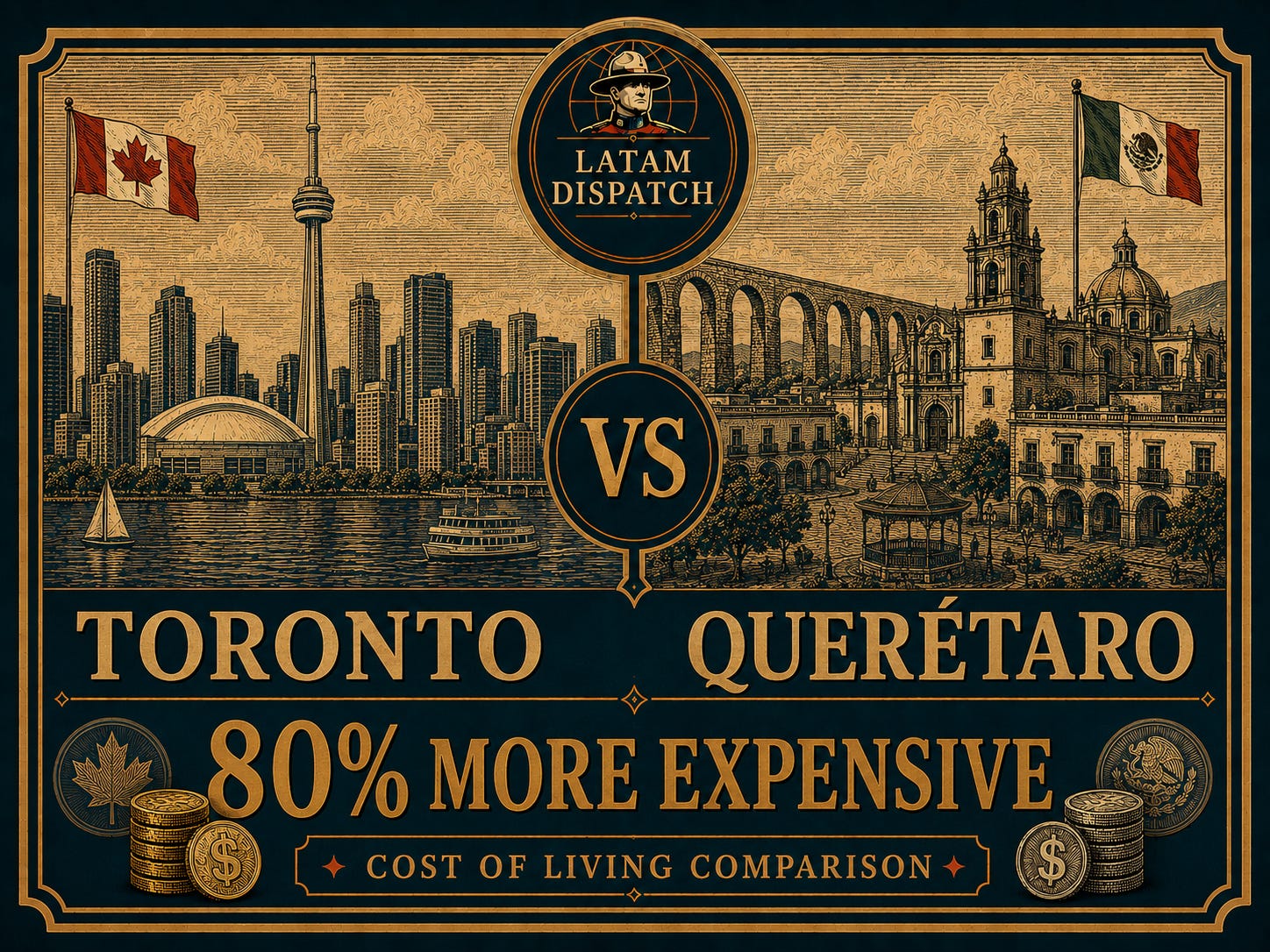
Expatistan, which uses user-submitted cost-of-living data, recently showed Toronto as about 80% more expensive than Querétaro. Put another way, Querétaro is still dramatically cheaper than one of Canada’s most punishing cities, while offering a modern urban life with industry, universities, restaurants, private healthcare, good roads, colonial charm, and enough bureaucracy to remind you that no country is perfect.
That is the key.
Mexico is not cheap everywhere, and it is not cheap for every lifestyle. But it can still give Canadians a decent margin.
A lower cost of living is not just about saving money. It gives you time. Time gives you options. And options are the entire point.
Comfort Is Not The Enemy
There is a certain type of Plan B thinking that makes everything sound like a survival exercise.
The more uncomfortable, remote, and inconvenient the destination, the more serious it must be. If you are not sourcing lightbulbs from a guy named Rodrigo three towns over, are you even trying?
I understand the instinct. A Plan B should not be built on luxury fantasies. You are not choosing a country because it has your favourite shampoo and a decent return policy.
But daily life still has to function.
This is one of Mexico’s underrated advantages. In many Mexican cities, familiar North American conveniences are not hard to find. Costco, Walmart, Home Depot, Sam’s Club, and Amazon Mexico make ordinary life easier than it would be in many other Plan B countries.
Do I miss Canadian Tire? Of course.
There are some wounds Mexico cannot heal.
But the broader point stands: Mexico gives Canadians a softer landing. You can learn Spanish, adapt to the local culture, shop at markets, eat real food, and build a life outside the Canadian bubble without turning every small errand into a logistical expedition.
Expat Communities Make the First Step Easier
Another advantage of Mexico is that you are not starting from scratch.
Canadians have been wintering here for decades. Long before “Plan B” became a phrase people whispered after reading the news, snowbirds and retirees were already heading south for better weather, cheaper living, and a few months away from Canadian winter.
After the Covid shenanigans, that stream changed. Mexico was no longer just a place for beach vacations and retirement condos. Many Canadians and Americans started looking at it as a pressure valve from governments that had become far too comfortable inserting themselves into daily private life.
Thousands of expats came south during those years, drawn by a country that, for all its flaws, often felt less suffocating than what they had left behind. Even Mexico’s left-wing president seemed to understand something many Western leaders forgot when he said, “The fundamental thing is to guarantee liberty.”
Many of those expats are still here today, and they have already gone through the headaches you are about to face. They know which neighbourhoods are livable, which government offices are painful, which doctors are decent, and which “helpful guy” is really just a walking invoice with a WhatsApp account.
That kind of foreigner infrastructure makes the first step less intimidating. English-speaking contacts, expat groups, bilingual churches, local guides, relocation consultants, and immigration lawyers are not hard to find in the major landing zones.
The trick is to use that network as a bridge, not a bunker.
Healthcare Without the Waiting Room Theology
Canadians are trained from birth to treat healthcare as a national sacrament. It is free, compassionate, and morally superior, or so the story goes. But that story becomes harder to swallow when people are waiting months for treatment while the same system grows increasingly comfortable offering MAID as a solution to suffering it has failed to properly relieve.
At some point, reality has to be allowed into the room.
Canada’s healthcare system is under serious strain. The Canadian Institute for Health Information reported in 2025 that wait times for surgery and diagnostic imaging remain a major priority, while the Fraser Institute’s 2025 survey reported a median wait time of 28.6 weeks between referral from a general practitioner and receipt of treatment.
That is not a minor inconvenience. For many people, it means months of pain, uncertainty, lost income, and a life put on hold while the system slowly decides when it is your turn.
Mexico’s public healthcare system has serious problems of its own, so nobody should pretend otherwise. But that is only part of the story. Mexico also has a private healthcare system that can be fast, modern, and surprisingly affordable for Canadians with savings, foreign income, or decent insurance.
In Mexico, private healthcare often feels shockingly direct compared to Canada. You do not need to beg a family doctor for a referral before seeing a specialist. In many cases, you can search for the specialist you need, check reviews, call the office, and book the appointment yourself. Many private specialists who work with foreigners speak English, and if you call early enough, same-day appointments are often possible. For Canadians used to waiting weeks just to begin the referral process, that alone can feel like stepping into another universe.
This is one reason medical tourism exists. Foreigners come to Mexico for dental work, cosmetic procedures, and more serious treatments because the price, speed, and access can make sense compared to what they face at home.
The trade-off is that you have to do more homework yourself. In Canada, people are used to letting the system filter their options. In Mexico’s private system, you have more room to choose, but also more responsibility for the choice. Check the doctor, read the reviews, ask around, and do not confuse easy access with automatic quality.
Mexico also offers a wider private and alternative healthcare marketplace than Canadians are usually allowed to consider at home. In the oncology world, for example, patients can more readily find clinics and doctors willing to discuss options such as high-dose IV vitamin C, hyperthermia, ozone therapy, metabolic approaches, immunotherapy-style programs, and repurposed-drug protocols that would be difficult, if not impossible, to access through the Canadian mainstream system.
The larger point is not that every option is equal. It is that Mexico gives patients more room to explore. That is the nature of a freer marketplace. More choice means more responsibility.
But for Canadians trapped in a system where “free” often means “eventually,” Mexico can become a serious healthcare hedge. This is not medical advice. It is a jurisdictional observation.
And optionality is the point.
Mexico Is Not Perfect
This is probably the point where we should take a breath.
Whenever someone writes positively about Mexico as a Plan B, there is a risk that readers hear it as a sales pitch. Palm trees, cheap tacos, quick healthcare, lower costs, and a life where all the Canadian nonsense somehow disappears at the airport.
That is not what I am saying.
Mexico is not paradise. Security varies dramatically by region. Bureaucracy can be maddening. Police corruption exists. Legal processes can be slow. Noise can be a daily reality. Sidewalks may attempt to kill you. Rules can change depending on the office, the official, the mood, and possibly the moon phase.
If you come to Mexico expecting Swiss efficiency with salsa, you are going to suffer.
Mexico requires patience, humility, situational awareness, and a serious effort to learn Spanish. You also have to accept that things often work differently here. In Canada, people are used to systems that at least pretend to be standardized. In Mexico, the written rule and the lived process are not always the same thing. Relationships matter. Local knowledge matters. Persistence matters.
Although, given the quality of Canadian government portals lately, perhaps this is less of a downgrade than advertised.
The point is not that Mexico is better in every way. It is not. The point is that Mexico is better right now in the specific ways that actually matter when you’re trying to build a real Plan B: it sits close enough that you can actually use it, living costs still give you breathing room, healthcare is far more accessible, the culture still has real weight, and daily life simply feels freer.
A first flag does not need to solve every problem. It needs to reduce your dependence on one country and give you another place where you can realistically spend time, build familiarity, access services, and create options before you desperately need them.
Mexico can do that.
If Mexico is starting to look like a serious first flag, the next practical question is residency.
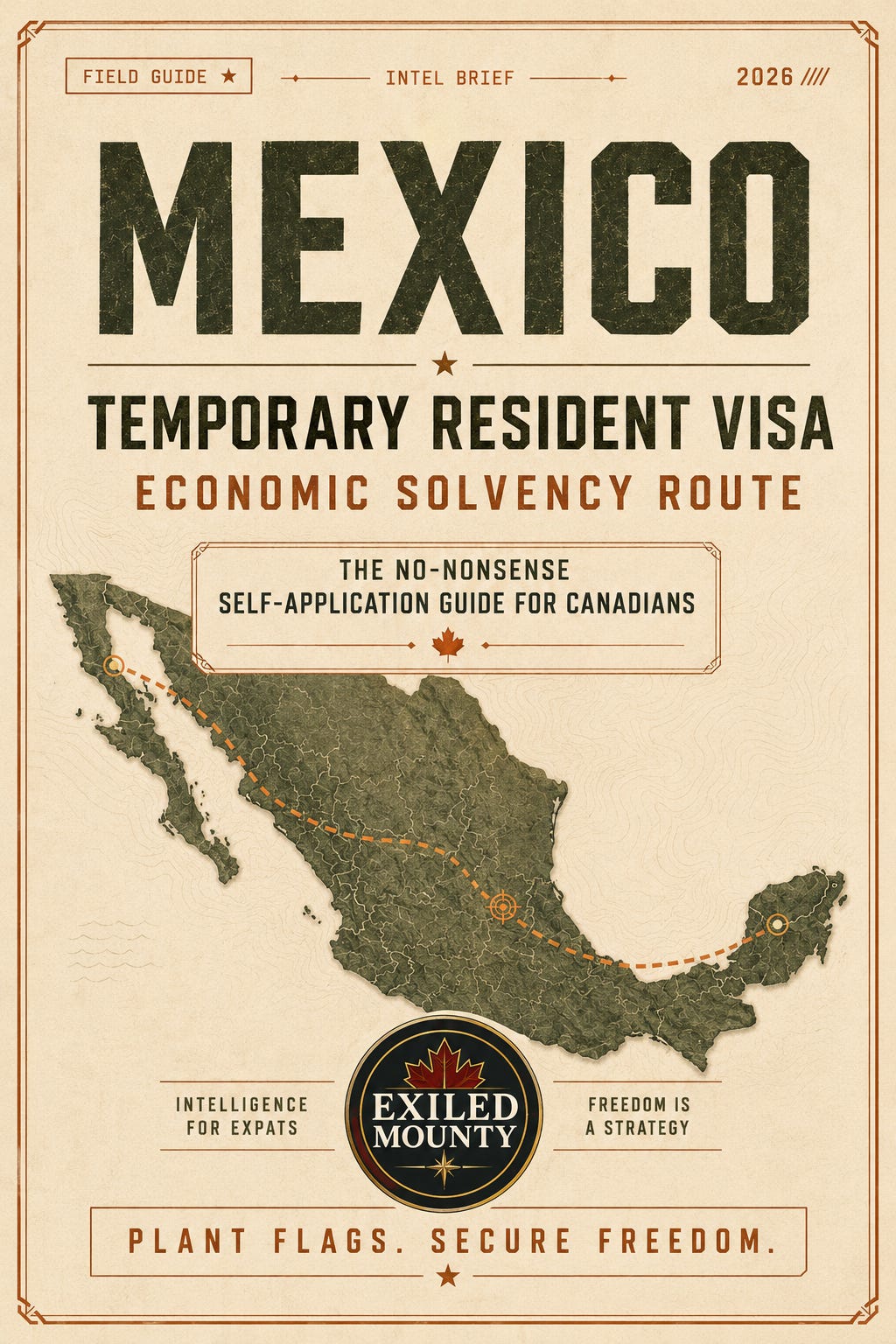
Tourist visits are useful for scouting, but a real Plan B usually requires something more durable. That is why I put together the Mexico Temporary Resident Visa Field Guide for Canadians who want to understand the basic pathway without getting buried in consulate gossip, Facebook contradictions, and outdated expat advice.
Get the guide at exiledmounty.com.
Stay free,
Exiled Mountie
If this resonated with you, subscribe for future essays, or follow me on X @tacosylibertad.
Receipts
https://en.www.inegi.org.mx/temas/religion/?utm_source=chatgpt.com
https://mexiconewsdaily.com/culture/mexico-in-numbers-religion/?utm_source=chatgpt.com
https://www.excelsior.com.mx/nacional/nuevo-leon-prohiben-espectaculos-drag/1675707?utm_source=chatgpt.com
https://grupoanimal.mx/estados/municipio-nuevo-leon-drag-queens-discriminacion?utm_source=chatgpt.com
https://www.theguardian.com/world/2020/dec/02/mexico-lopez-obrador-pandemic-lockdowns-dictatorship
https://www.fraserinstitute.org/studies/waiting-your-turn-wait-times-for-health-care-in-canada-2025?utm_source=chatgpt.com
https://www.cihi.ca/en/wait-times-for-priority-procedures-in-canada-2025?utm_source=chatgpt.com
This is a fantastic summary of the pros and cons and could only be written by someone who has gone through the process and is living in Mexico. We chose Mexico for exactly the same reasons -- it was a cheap and easy residency to get and Mexico backed off the Covid nonsense more quickly than most (Nicaragua was an interesting outlier that didn't mandate anything). Panama didn't drop their mask mandate until after Canada which was a key reason we chose Mexico as our Plan B; we're now in the process of getting Panamanian residency.
Another huge benefit of Mexico and LATAM is their reliance on cash. I love that the word for cash in Spanish is efectivo! I'm under no illusions that this part of the world couldn't go the way of the west but it'll happen much more slowly...one of the benefits of inefficiency. There are too many unbanked Mexicans for the government to introduce a CBDC and there are still lots of local shops and restaurants that are cash only.
I totally agree that if you don't have Spanish you need to be somewhere with an expat infrastructure. We hired someone to get us through the residency process and in our town there are lots of consultants, like a medical concierge, who can help you navigate the legal, medical, and immigration systems.
Given there is no investment requirement or a requirement to spend a certain amount of time on the ground to maintain your residency, there is no better place for a Plan B than Mexico.
Excellent!