
Most Canadian students can name American presidents, civil rights leaders, and Hollywood legends before they can name ten Canadian heroes.
They know very little about:
the March West of the NWMP
the building of the railway
the history of the Hudon’s Bay Company and the fur trade
the RCMP’s Northwest Passage expedition
the settlement of the West
The Gold Rush
the sacrifices of Canadian soldiers in two world wars
These were no small feats.
These were stories of men crossing impossible distances, families carving farms out of the wilderness, builders laying steel across mountains and muskeg, police riding into the unknown to bring law and order to the frontier, sailors and explorers pushing through ice and darkness, and soldiers leaving quiet Canadian towns to fight in wars that stopped murderous ideologies cold in its tracks.
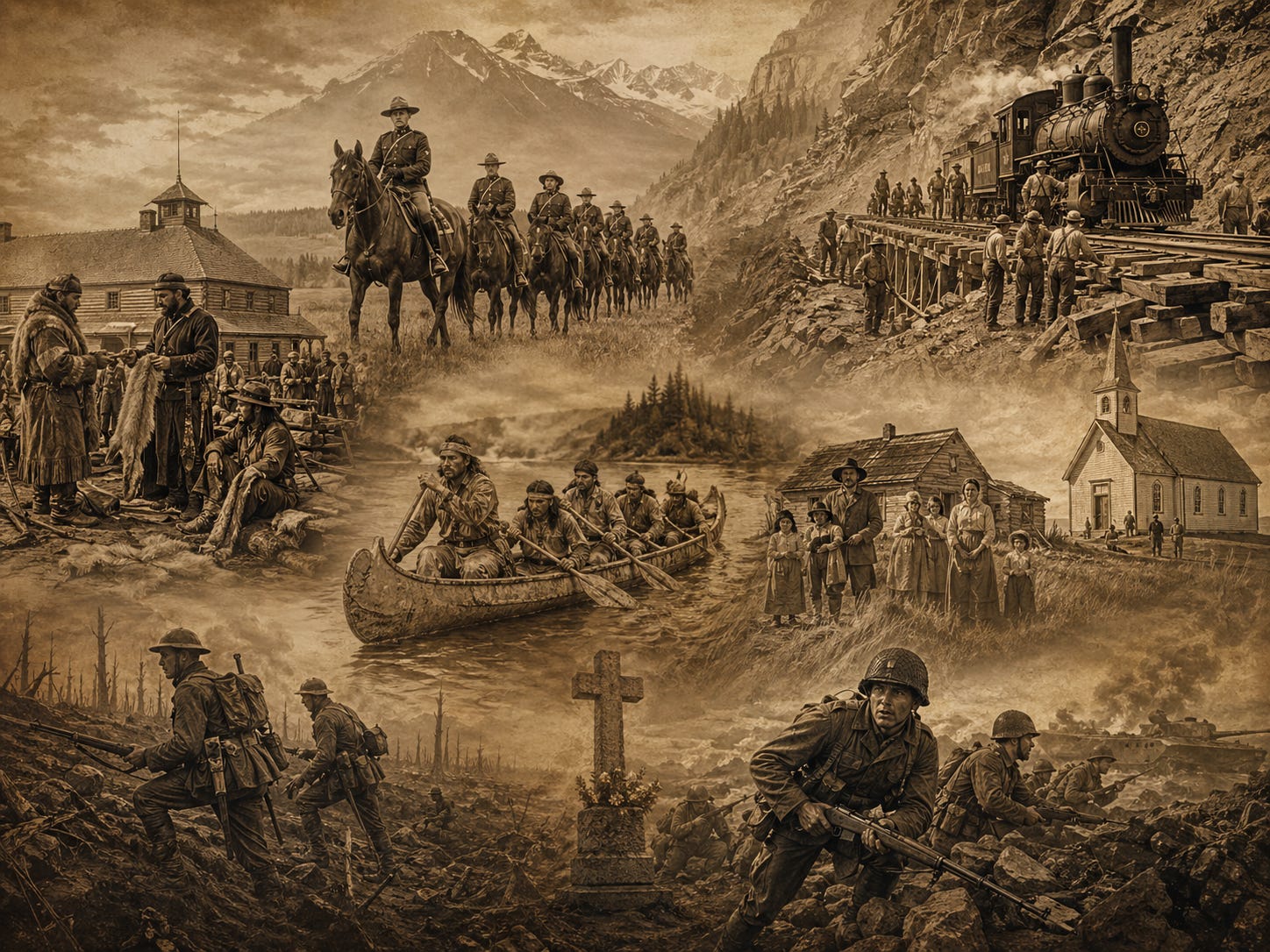
These stories are not myths. They are our inheritance.
They shaped our country, and taught us to be courageous, to have faith, to endure in challenging times. They also taught us who we are.
And yet, how often are these stories taught with pride?
A healthy country teaches its children both truth and gratitude. It does not lie about the past, but neither does it teach its children to despise the people who came before them. It tells them that they have received something valuable, costly and worth preserving.
A Nation Taught to Forget
Too many young Canadians are growing up disconnected from their own history. If they are taught any national history at all, it is often presented through the lens of failure rather than achievement, so that an attitude of self-loathing and shame is instilled rather than pride.
Furthermore, school kids are being taught to look inward and to be consumed with gender ideology and pronouns. A whole generation of Canadians are growing up feeling ashamed of themselves and feeling as though they do not belong.
This is by design, of course.
It is part and parcel of the ideological subversion and demoralization process that has been ongoing for decades now. When you teach a population to hate itself, and to apologize for merely existing, that population tends to become docile and apathetic. A broken people is much less likely to resist and far easier to control.
We can see the fingerprints of this clearly in Canadian society: endless land acknowledgements, DEI programs that divide people into oppressor and victim classes, and public institutions that seem far more comfortable apologizing for Canada than celebrating it. The message is always the same: your history is shameful, your ancestors were villains, and your inheritance is something to be repented of rather than preserved.
Stories about heroes, sacrifice, settlement, endurance, and nation-building instil confidence, grit and identity. Patriotic countries, like the United States, frequently celebrate their heroes in popular culture, books, and movies.
Where are our movies?
Where is the great Canadian film about the March West? Where is the sweeping historical drama about the building of the railway against all odds? Do we have any movies about the fur trade, the forts of old, the explorers, the missionaries, the Mounties, and the families who endured brutal winters and impossible challenges to build something lasting?
Americans turn their frontier into legend. They put their heroes on the screen and carve them out of mountains.
We bury ours.
Do most Canadians even know the names of more than ten historical Canadian heroes?
Instead, we celebrate every imported cause, activist-approved observance, and foreign tradition while neglecting our own. We perform land acknowledgements and apologize when no apology is due.
If that is not orchestrated demoralization, I don’t know what is.
The Postnational Lie
Then-Prime Minister Justin Trudeau famously said during a 2015 New York Times Magazine interview, “There is no core identity, no mainstream in Canada” and further argued that this made Canada “the first postnational state”.
That statement was not just some offhand comment. It was a worldview. And a bleak one, at that.
If a country has no core identity, then there is nothing to preserve and nothing to defend. There is nothing to pass down to subsequent generations and nothing sacred to cherish. The country merely becomes an economic zone with a flag, a tax system, and a collection of competing interest groups that lobby for influence.
I disagree that there is no core identity in Canada.
It is there, but it has been buried because it is no longer celebrated or told in a way worth remembering.
Remember Who We Are
If there is any hope of salvaging this once-great country, we must return to our roots. We must remember where we came from, what we achieved, and most importantly: who we are. We must remember our heroes and tell our stories. We must celebrate our holidays with pride. We must rebuild the churches that have been burned down. We must return to the values of old, and reject the destructive social ideologies that only serve to divide us and confuse our children.
And we must remember God, who has been with us since the beginning. Canada was not built on shame, self-loathing and ideological confusion. It was built on faith, family, sacrifice, law, duty, hard work, and with the hope of leaving a strong foundation to future generations.
If my people, who are called by my name, will humble themselves and pray and seek my face and turn from their wicked ways, then I will hear from heaven, and I will forgive their sin and will heal their land. - 2 Chronicles 7:14
Pick up a book about our history and read it! Share it with your kids. Talk about it.
The schools won’t do it, so you have to.
If you’ve got any recommendations for good books about Canadian history, or a good Substack for that matter, I’d love to hear about it!
Stay free,
Exiled Mountie.
as a canadian living abroad, and visiting canada annually for extended periods, i do believe that canadians still have a core identity. only one: they hate trump. they honestly believe this is enough to hold a nation together and to keep it strong, resilient and successful.
There is a book called The riders of the plains written in 1903 by C.E. Denny who was one of the original NWMP who came west to stop the whisky trade and chaos.
Reprints available from Leopold Classic Library. Very good and influential look at the times.