Belize: The English-Speaking Flag Hiding in Latin America
A Commonwealth country with territorial-tax appeal, direct property ownership, a dollar-pegged currency, and a Caribbean way of life

For many folks looking to plant a flag outside their home country, Latin America is the obvious place to start.
It is close enough to inspect without crossing the world. The cost of living is often significantly lower than back home, and there is already some familiarity through winter travel and resort visits. Much of the region also retains a Christian and family-centred identity that does not feel entirely foreign.
However, Spanish is a big stumbling block for many. As someone who has lived in Latin America for 5 years, I can tell you that the constant struggle of trying to get things done in Spanish gets old fast.
Translation apps can get you through a menu without problems, but they are less comforting when you are dealing with anything that requires a bit more finesse or nuance. For some people, that language barrier is enough to keep the whole Plan B conversation on ice.
This is where Belize throws you a line. It is almost as if the gods of flag planting took pity on the lowly Canadian exile by creating a small English-speaking outpost on the edge of the Spanish-speaking world.
For anyone who wants to plant a flag abroad but hesitates because of the language barrier, Belize may be one of the easier places to start.
Belize Is an Odd-Ball
Belize is a melting pot in its own right. While the country is located in Central America, many of its institutions, its official language, and parts of its culture come out of the Commonwealth world.
The culture itself has a strong Caribbean influence, with Belizean Kriol widely spoken alongside English. The Garifuna people, whose ancestry combines West African and Caribbean roots, add another distinctive layer to the country’s culture.
Add Mestizo communities, Mennonite farms, Maya traditions, and a growing number of expats from North America, and you end up with a country that is far more varied than its small size would suggest.
A Short History: Why Belize Speaks English
Belize’s English-speaking identity did not happen by chance. It grew out of a rough frontier world of seafarers, privateers, timber camps, and Caribbean trade, with British settlers pushing into territory claimed by Spain.
Unlike its neighbours, Belize did not share the same origins as the typical Spanish colony, with its grand inland capitals and centralized administration. Its early economy was built around logwood and mahogany, with slavery woven in from the very beginning. The result was a settlement that developed along a very different track from the Spanish republics surrounding it.
Over time, the territory became the British colony of British Honduras. The name was changed to Belize in 1973, and the country gained full independence in 1981 while remaining a member of the Commonwealth.
Belize speaks English because it emerged from a very different colonial path than the rest of Central America. It carries British legal traditions, Caribbean cultural influences, and Central American geography all at once. That unlikely combination is what makes Belize feel so different from the countries around it.
The Flag-Planter Appeal: The Bundle
The reason I like Belize as a Plan B is that it offers several advantages in one small country.
Apart from being able to conduct your affairs in English, Belize generally allows foreigners to own property directly. This might sound like a no-brainer. But if you’ve spent any time looking at real estate in Mexico, you’ll know that buying near a coastline or international border can involve inviting a bank into the relationship, and the bank, naturally, expects to be paid for the privilege. Having the ability to purchase property without the headache of dealing with bank trusts and the ongoing costs associated with them is a huge bonus.
Belize also has an attractive tax angle, particularly for people who qualify for the QRP and receive income from outside the country. Under that program, foreign-source income can be exempt from Belizean taxes and duties. Set up properly, and with your obligations back home dealt with, you could potentially keep all of your money and be in the rare position of living completely tax-free. Governments everywhere will somehow find the courage to carry on.
Another benefit is that the Belize dollar is officially fixed at BZ$2 to US$1. That makes the mental math fairly painless when planning purchases or comparing costs: BZ$100 is US$50, and BZ$300,000 is US$150,000.
In terms of residency, Belize offers pathways that are relatively easy to understand and, for the right applicant, attainable. More on those below.
Residency: The QRP and the 40+ Surprise
Belize has a straightforward Plan B pathway through its Qualified Retirement Program, usually shortened to QRP. The surprise is that you do not need to be anywhere near the traditional retirement age in order to qualify.
The word “retirement” makes most people think of someone in their sixties or seventies. In Belize, you can retire a lot sooner. The official Belize Tourism Board (BTB) describes the program as available to people aged 40 or older who receive qualifying funds or income from outside Belize. The income threshold is US$2,000 per month or US$24,000 per year, and approved currencies include U.S. dollars, pounds sterling, euros, and Canadian dollars. Qualifying income can include pensions, annuities, social security benefits, investment accounts, inheritance, and reverse mortgages.
That makes the word “retirement” a little misleading. Belize may be relevant not only for traditional retirees, but also for early retirees, pensioners, people living on investment income, and others with foreign income who are looking for a softer landing.
What If You Are Under 40?
That is all well and good, but what if you are under 40 or do not have the kind of income required for the QRP?
Luckily, the QRP is not the only way to establish yourself in Belize. The other options are not quite as clean, though, and generally require more patience.
A younger applicant can work toward permanent residence by living legally in Belize for at least one year and spending no more than 14 days outside the country during that period. Applicants also need to show financial stability and meet the usual criminal-record and documentation requirements. In practice, that usually means living in Belize on properly extended visitor status for the year before applying for permanent residence.
Remote workers from Canada, the United States, the United Kingdom, or the European Union may also qualify for Belize’s Long Stay Permit. That route is designed for people employed outside Belize and currently requires annual income of at least US$75,000 for a single applicant or US$100,000 with dependants.
There is also a temporary residence category for people making a substantial commercial investment in Belize, although the required BZ$500,000 investment is no small gesture. Anyone planning to work locally will normally need a Temporary Employment Permit instead.
The longer-term attraction is that permanent residence can eventually open the door to Belizean citizenship. The official immigration rules allow permanent residents to apply for citizenship by registration after holding permanent residence for at least five years, subject to the country’s residence and travel requirements. So, while the under-40 route demands more patience at the beginning, it can lead beyond temporary status and toward a full second nationality.
So, being under 40 does not rule Belize out. It simply means the QRP is probably not your route.
From Island Condos to Inland Acreage
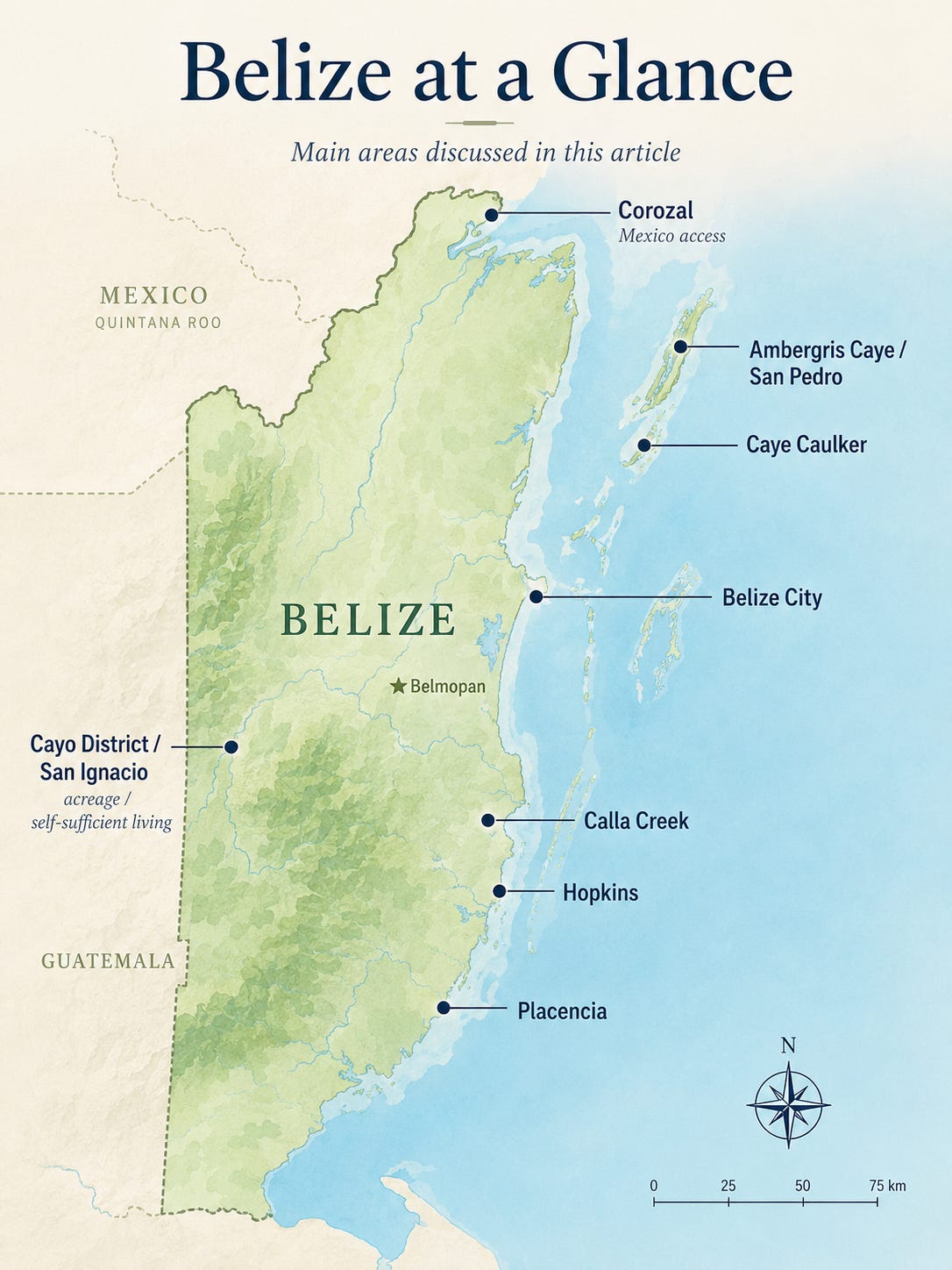
Belize is made up of several property markets, each appealing to a different kind of buyer.
Ambergris Caye and Caye Caulker are island and tourism markets heavily shaped by visitors, expats, and the dream of Caribbean water. Placencia and Hopkins offer a coastal lifestyle, but they are not necessarily bargain-bin destinations simply because they are in Central America. Cheap, easy oceanfront houses are not exactly a dime a dozen here.
Corozal has a quieter northern appeal, with a more retiree-oriented feel and some of the more affordable coastal property in Belize. Its proximity to Mexico is a major part of the attraction. Chetumal is just across the border, giving residents access to larger shops, malls, specialist healthcare, and services that are harder to find in a small Belizean town.
Cayo is a different flavour altogether. It is inland, greener, full of jungle, rivers, farms, and open land, and often offers better value than the island and coastal markets. This is probably the part of Belize most likely to appeal to the self-sufficient type, or the prepper who would rather look at acreage than condo fees. You give up the Caribbean view, but you may gain more land, privacy, and room to build something of your own.
Then there is Belize City, which offers the country’s deepest concentration of services, infrastructure, and commercial life. It also requires more careful neighbourhood research. Southside Belize City has a well-established reputation for violent crime and gang activity, while other neighbourhoods are generally less troubled. This is not a place where you choose a house from a national crime statistic or a realtor photograph alone.
For buyers chasing the lowest prices, inland Cayo and quieter parts of Corozal are usually the first places to investigate.
Property Watch: A Small Homestead in Calla Creek

For a better idea of what the rural Cayo option can look like, I found a furnished two-bedroom home in Calla Creek listed at US$168,000.
The house sits on 2.4 acres and already has many of the ingredients someone would look for in a small homestead. There are fruit trees, room for gardens and chickens, and an animal stall that could accommodate goats, sheep, or even a horse. The A-frame home has been remodelled and comes furnished, so this is not simply a patch of jungle accompanied by an optimistic realtor description.
The location also strikes a decent balance. Calla Creek offers rural surroundings and room to breathe, while San Ignacio and Benque Viejo del Carmen are both roughly 15 minutes away. You can have land, animals, and some privacy without needing to abandon civilization entirely.
For the self-sufficient type who would rather have acreage than an island condo, this is the kind of property that makes Cayo interesting. It is not a sprawling ranch, but it has enough land and existing infrastructure to begin building a more self-sufficient life.
Rent First
It is almost always a good idea to rent before jumping headfirst into buying property. Life in Latin America, including Belize, is not always what it seems on a first visit. On a short trip, everything has a way of looking fresh and new, while the quirks that might have you pulling your hair out after six months can seem fun, charming, or even appealing when you are only passing through.
Give the place time to reveal its full personality. I like to think of it as dating: you court her for a while to see whether you are a good fit and whether you can live with the less attractive habits that tend to surface once familiarity sets in.
This advice is especially worthwhile in Belize, where the lifestyle can change completely depending on where you settle. Island life, a coastal village, the inland jungle, Belize City, or a northern border town can feel like entirely different countries once the novelty wears off.
While you are renting, pay attention to the ordinary things. Can you handle the humidity after the first few days? How does the place feel during hurricane season? Is the internet reliable enough for work and Netflix? What happens when the power goes out? Are groceries, fuel, repairs, and transport manageable? Where would you go for a doctor, a specialist, or an emergency? Do you need Mexico nearby for shopping, healthcare, or flights? And perhaps most importantly, do you still like the place on an ordinary Tuesday afternoon when nothing interesting is happening?
Those questions will start to matter a great deal after a couple of months. If you jumped the gun and bought the place, you may simply have to make peace with whatever is hassling you. If you are renting, you can simply move elsewhere and try again.
Renting first also gives you time to understand the local property market. You begin to see which roads flood, which neighbourhoods change after dark, which areas are noisy, where insurance becomes expensive, and which listings have been sitting for a reason. None of that shows up clearly in polished listings.
Belize is small enough to scout, but varied enough to punish assumptions.
Cost of Living: Simplicity Pays in Belize
Renting first does more than protect you from a bad property decision. It also gives you a chance to discover what life in Belize actually costs.
Belize is affordable, and some expenses may be considerably lower than back home. Others are surprisingly high, especially for imported goods, electricity, vehicles, and anything sold in the main tourist areas.
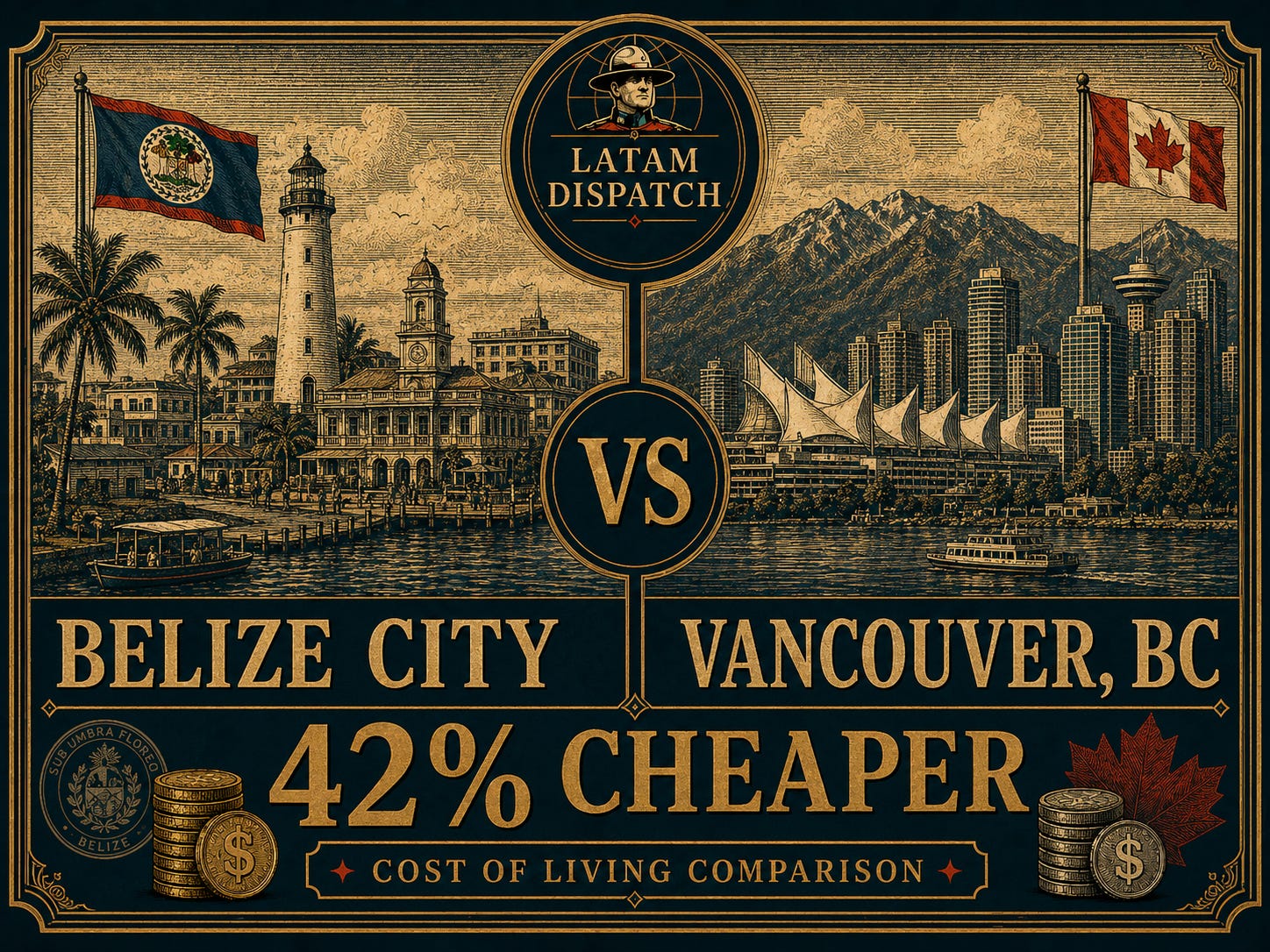
Expatistan currently estimates that living in Belize City is about 42 percent cheaper than living in Vancouver. Housing shows the largest gap, while food, transportation, personal care, and entertainment also come in lower. Clothing is the odd one out, with prices slightly higher in Belize City, presumably because paradise still has to import your pants.
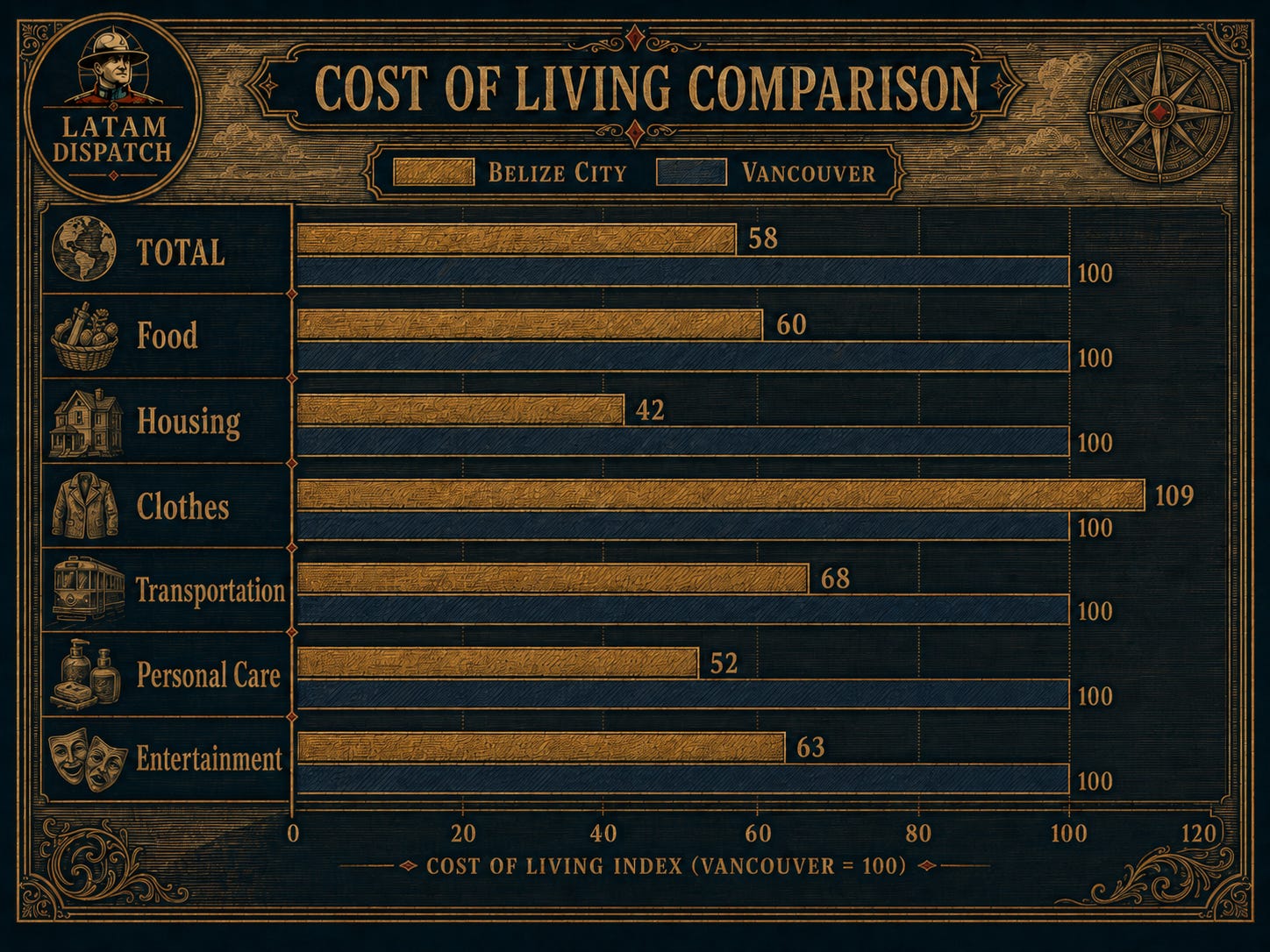
The basic pattern is easy to understand. Belize produces some things locally, but many of the goods outsiders expect are brought in from somewhere else. Imported groceries, appliances, electronics, vehicles, building materials, replacement parts, and familiar brand-name products all carry a premium. Electricity, fuel, insurance, repairs, and restaurant meals in the main tourist areas can also cut into the idea that life will be inexpensive simply because the climate is tropical.
A modest life in Cayo or a quieter northern community may look very different from life on Ambergris Caye. Inland, a person may find more space, lower housing costs, and fewer tourist premiums. On an island or in a popular coastal zone, almost everything has to move through a more expensive chain of transport, labour, storage, and demand.
Lifestyle matters just as much as geography. A person who eats local food, rents a simple home, avoids imported luxuries, and accepts a slower standard of convenience may find Belize manageable. Someone who expects air conditioning running all day, imported groceries, a newer vehicle, frequent restaurant meals, beachfront living, and immediate access to every familiar product may discover that the budget rises quickly.
That is another reason the scouting period is important. A month of paying your own way and dealing with ordinary life will teach you more about Belize than any online cost-of-living chart.
Healthcare, Amenities, and Small-Country Reality
Apart from the residency pathways, territorial-tax appeal, and English language, what else does Belize have to offer?
Belize is a small country by almost any measure. It covers roughly 23,000 square kilometres, making it a little larger than Wales and somewhat smaller than Massachusetts. Its estimated population in 2026 is only about 426,000 people, fewer than many North American cities.
That low population is part of the appeal. As much as I love Mexico, there are simply too many people for my liking. I value being able to disappear into nature, find some solitude, and put a little distance between myself and the rest of humanity without needing to organize a full expedition.
Belize offers plenty of that breathing room, but smallness comes with a price. Development is slower, and the infrastructure is thinner than what most Canadians or Americans are accustomed to. There are fewer hospitals, medical specialists, schools, flights, suppliers, and entertainment options. Many of the services you take for granted back home either exist on a smaller scale or require more patience.
Healthcare is where those limitations become most apparent. Routine care may be adequate for a healthy person, but anyone with ongoing medical needs, a complicated condition, or a good chance of requiring specialist treatment has to think beyond the nearest clinic. Medical facilities are limited, prescription availability can be unreliable, and serious cases may require evacuation abroad.
The same goes for ordinary amenities. While one person may be perfectly happy with a smaller grocery selection and fewer restaurants, another may discover that what felt pleasantly old-fashioned on vacation becomes irritating when the same limitation turns up every week.
This is where Belize’s proximity to Mexico becomes more important. For someone living in the north, nearby Mexico can fill some of the gaps when it comes to shopping, healthcare, flights, supplies, and a broader range of services.
A Note on Firearms
I always like to include a note on firearms when a country offers a mechanism for ownership, because they are such a natural part of rural Canadian and American culture. For someone looking at a self-sufficient lifestyle in rural Belize, the subject is likely to come up sooner or later.
Belize does have a formal firearm-licensing system. The official application covers various firearm types, with licensing categories that include farmers and sport hunters, among others. Applicants are required to state why they want the firearm, identify the type and calibre, provide references, complete approved firearm training, and submit a police record and proof of address.
The residency question is less straightforward. The current application asks whether the applicant has been domiciled or ordinarily resident in Belize for at least two consecutive years. In other words, holding a particular residency card may not be enough on its own. If you are considering owning a firearm in Belize, you should confirm how the government treats your specific residency category before building that into your plan.
For the rural flag planter, the encouraging part is that legal ownership is possible and the system recognizes rural purposes such as farming and sport hunting.
Why Belize Earns a Place on the List
After all the warnings about limited healthcare, fewer amenities, and the realities of life in a small country, it is worth remembering why anyone looks at Belize in the first place.
This small country is genuinely big on outdoor life. Whether you are drawn to the water for snorkelling, fishing, and boating, or prefer a more self-sufficient life farther inland, Belize probably has something to offer.
If you simply want a decent Plan B in your back pocket, Belize checks a surprising number of boxes, not least the ease of conducting daily life in English. And if you are looking for a more permanent base, it is possible to build a life here while still remaining relatively close to home.
Bottom Line
Belize is not the cheapest option in the region, nor will it be the best fit for everyone. But it offers something none of the other Central American options do: English as the official language.
For some folks, that will be the main reason they consider Belize. Others may be drawn to the outdoor life, direct property ownership, or territorial-tax appeal. Whatever the attraction, Belize offers a straightforward residency pathway for people aged 40 or older who have qualifying foreign income. Even if you do not tick those boxes, there are still other routes available.
You can generally own property directly without dealing with the bank trusts and ongoing trust fees required in parts of Mexico. Belize also sits next door to Mexico and remains relatively close to Canada and the United States, which makes it easier to scout, revisit, or keep as a Plan B without disappearing to the other side of the world.

If you’re ready to go beyond the overview, the Belize Residency Field Guide takes a closer look at the practical side of the move: residency pathways, document requirements, timelines, costs, property considerations, tax questions, and the details that matter before you commit.
Explore the Belize Residency Field Guide and build the file before you build the fantasy.
Stay free,
Exiled Mountie
I ve been through corazal and ambergris is nice. Best part of the trip was driving from Cancun to Corazal and then flying smaller plane to San Pedro over the jungle and Caribbean reefs. Beautiful place and nice people. Sadly I never got to see the southern parts of the country or Belize City or Belmopan! But the people all seemed friendly and helpful to touristas.
Thank you for sharing all this significant info. Much Gratitude 🙏🏻